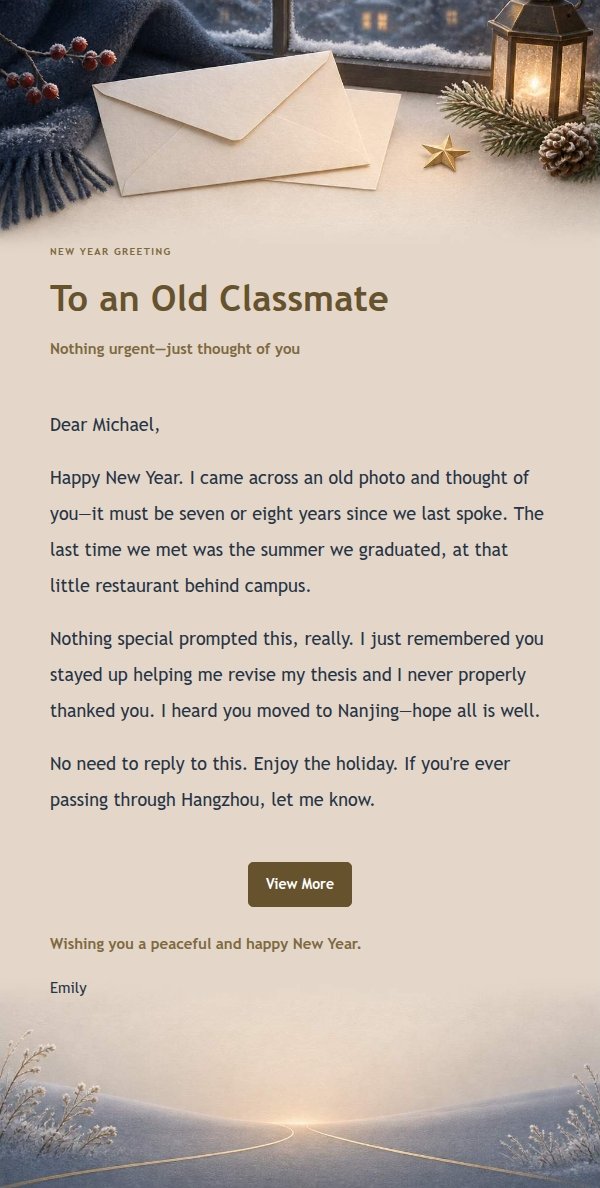
The hard part is not saying Happy New Year. It is acknowledging time has passed without making the other person wonder what you want. A New Year email to someone you have not spoken with in years does not need a long explanation, a grand reconciliation speech, or a hidden request. It needs a reason, one shared detail, and room to respond.
Why the first email feels harder than it looks
After years of silence, an unexpected email can prompt: "Why now?" That is not unfriendly. It protects time and energy.
You do not need to account for every year apart. Remove two worries: you are not asking for something, and they are not expected to recreate the old relationship on demand.
Decide whether a New Year greeting is the right container
Use this approach when you have a genuine reason to think of the person, can accept no reply, and are not introducing a pitch, favor, or request.
Choose another email when the real subject is an unresolved conflict, a substantial apology, or a work proposal. Do not hide a difficult topic behind seasonal warmth. If you need to thank a professor and also own a delayed apology, start with a thank-you and apology email to a professor after years.
Build the message around four small decisions
Begin with the moment that brought them to mind
An old photo, a graduation project, a book, or a familiar street gives the email a grounded opening. It simply answers: why write today?
Keep one specific memory, not a life recap
"Thank you for all your help" is kind but general. One detail is warmer: "You went through my slides line by line before my defense." It makes the thanks recognizably theirs.
State the lack of an agenda lightly
Do not insist that you have no hidden motive. "I'm not writing because I need anything" is enough.
Make the freedom not to reply real
"Please write back when you can" can turn a warm hello into a task. "No need to reply right away, or at length" is more useful.
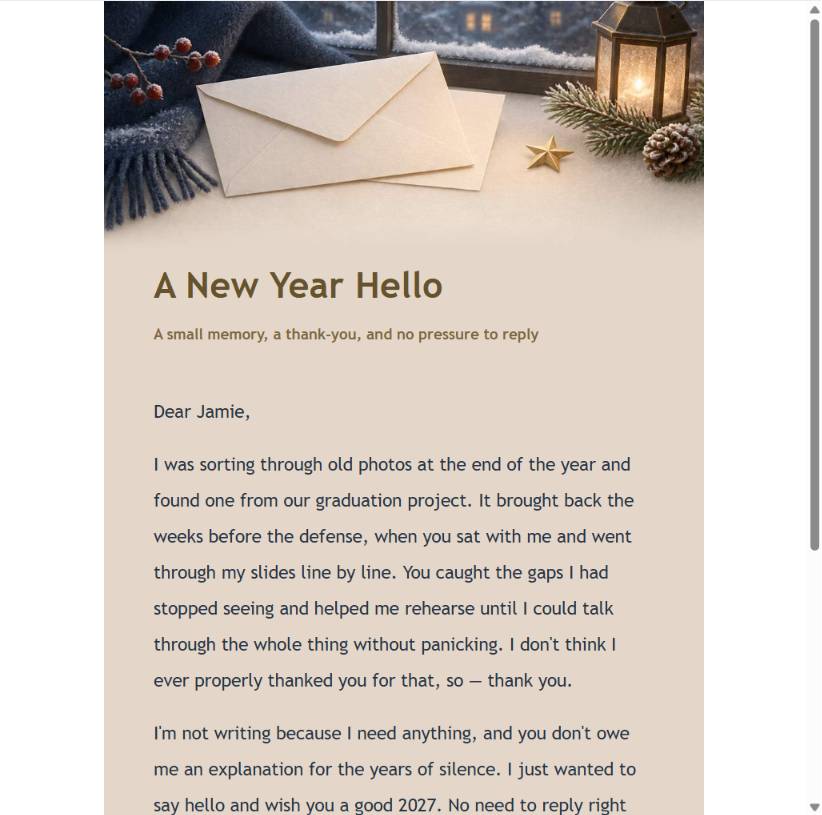
New Year reconnection email example
Subject: A New Year hello, and a thank-you I have meant to send
Dear Jamie,
I was sorting through old photos at the end of the year and found one from our graduation project. It brought back the weeks before the defense, when you sat with me and went through my slides line by line. You caught the gaps I had stopped seeing and helped me rehearse until I could talk through the whole thing without panicking. I do not think I ever properly thanked you for that, so thank you.
I am not writing because I need anything, and you do not owe me an explanation for the years of silence. I just wanted to say hello and wish you a good 2027.
No need to reply right away, or at length. I hope the new year treats you well.
Warm wishes,
Sophie Grant
The message does not ask Jamie for a full update, a call, or reassurance that the friendship is unchanged. In a first reopening note, space matters more than volume.
What makes a kind note feel demanding
- "Why did we ever lose touch?" asks them to explain the gap.
- "Tell me everything you have been doing" can feel like homework after a long silence.
- "I hope we can go back to how things were" puts an emotional outcome on one email.
- "I actually need a quick favor" changes the meaning of the greeting. If you have a request, write a separate email and say so clearly.
For an ordinary seasonal note to people you already speak with, Christmas wishes for friends and family is a better fit.
A greeting and a reconnection are not the same thing
An ordinary holiday email can be brief. A reconnection email recognizes a shared past without requiring the recipient to process it immediately. One trigger, one memory, one sentence that removes pressure, and one calm closing are enough.
What the visible template test showed
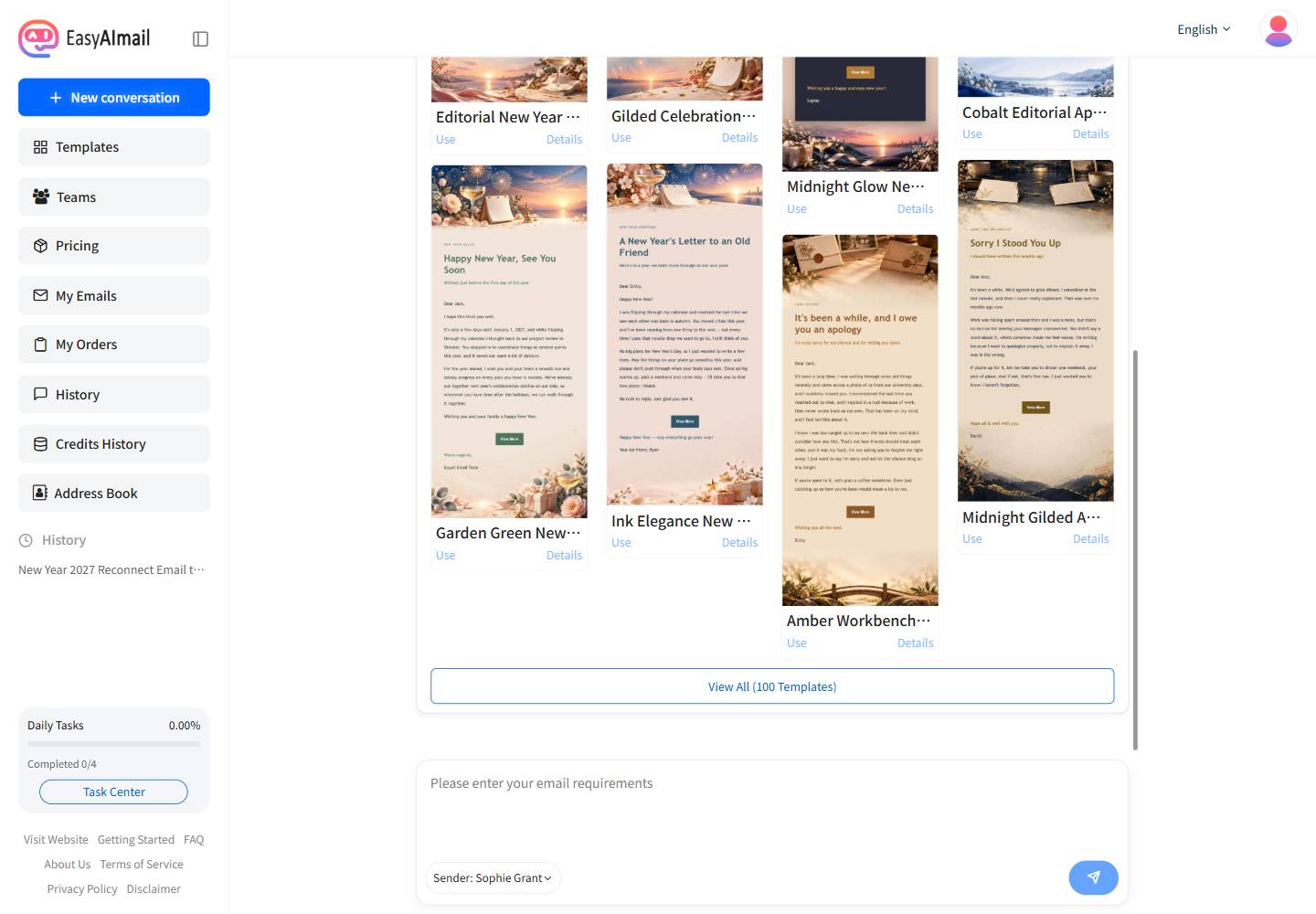
In this English-interface test, the simulated user began with a specific concern: a New Year 2027 note to a university classmate after more than four years out of touch, with no hidden request. EasyAImail recommended templates first. The user opened the details and chose "Year-End Reconnection New Year Letter."
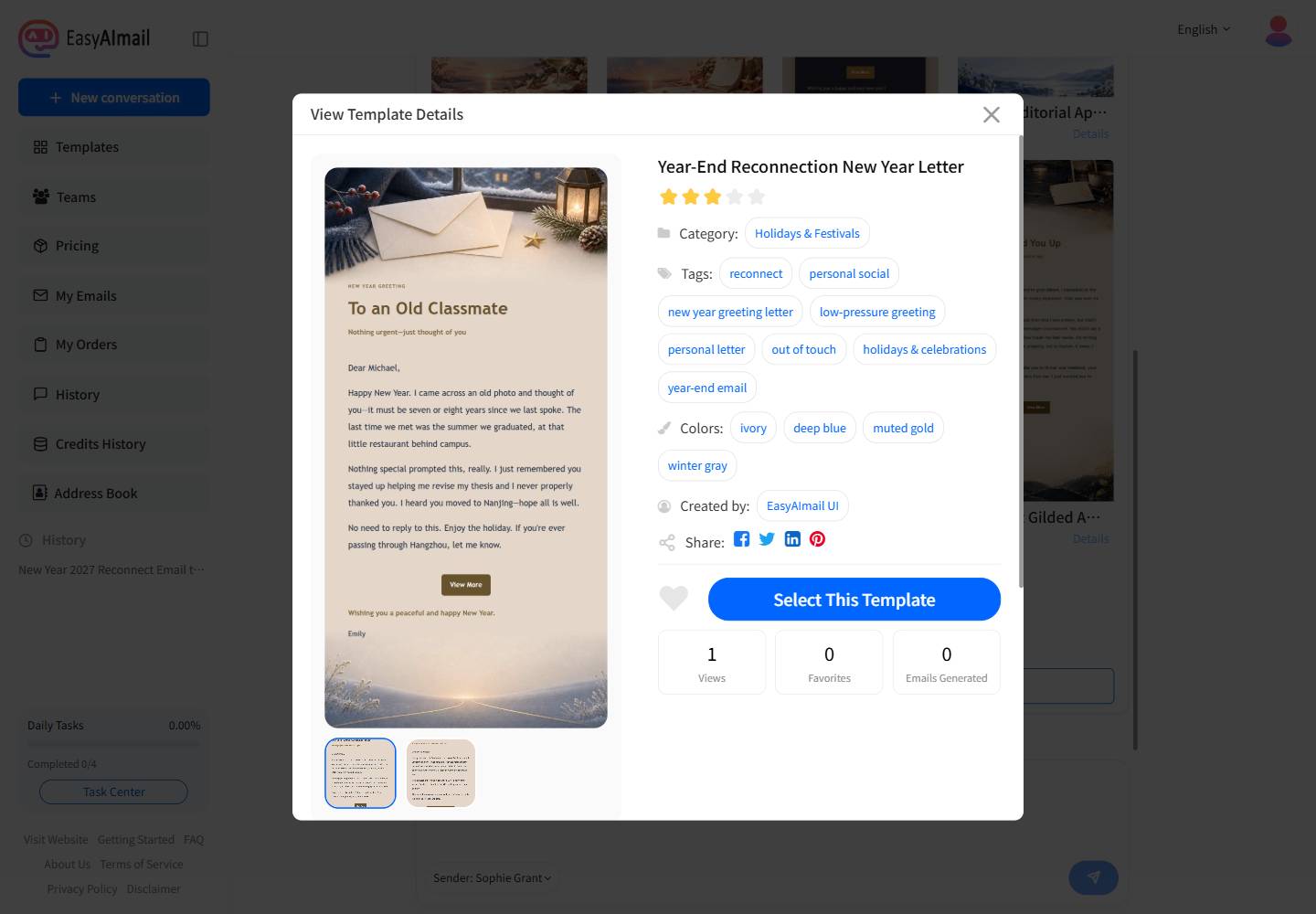
The choice was not just about the words "New Year" in the name. The visible details named reconnecting, being out of touch, a personal letter, and a low-pressure greeting. Its ivory, deep-blue, and muted-gold layout reads like a quiet letter, not a celebratory blast.
Use EasyAImail without outsourcing the relationship judgment
With EasyAImail, you describe the recipient and what makes the email difficult. AI recommends potentially relevant templates; you review the details and select one. It asks for missing facts, then you preview the complete HTML email, revise it if needed, and decide whether to send it.
The tool shapes your intent into a complete email. The relationship judgment and final sending decision remain with you.
FAQ: Frequently asked questions
Is it awkward to email someone at New Year after years of no contact?
Not usually, when the note is specific and asks for nothing. A small memory and a low-pressure closing are enough.
Should I explain why I have not been in touch?
Usually no. Unless you owe a real apology, one light acknowledgment of the time apart is enough.
Can I ask how they have been?
You can, but avoid stacking questions. Let them decide how much to share.
What if they do not respond?
Do not chase the note. Write again later only when another genuine, low-stakes reason arises.
Related resources
- A thank-you and apology email to a professor after years is for a reconnection that also needs a delayed apology.
- Christmas wishes for friends and family helps separate an ordinary seasonal greeting from reconnecting after a long gap.
Before you send it, make sure the email leaves room for connection rather than pressure to reply.