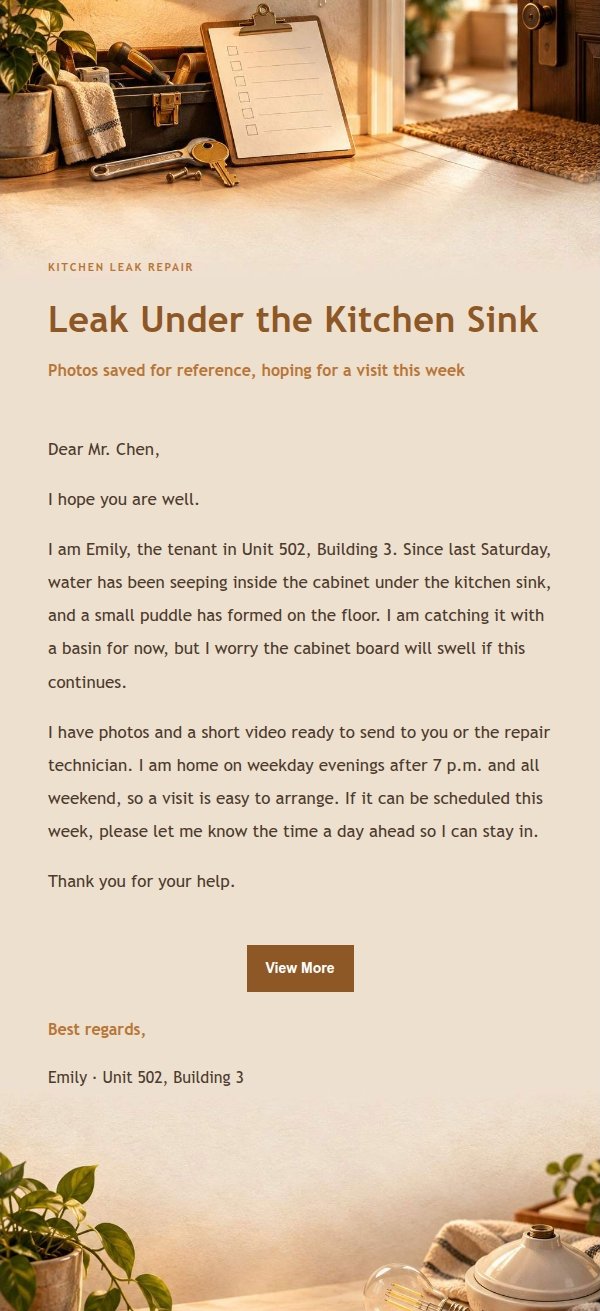
When something in a rental needs attention, Start by describing the problem clearly. A repair request email does not need to sound angry to be taken seriously. It needs enough usable information for a landlord or property manager to understand what happened, locate the issue, and arrange a next step.
That usually means a specific location, the date you noticed the problem, what you can actually observe, any useful photos, and realistic times for access. This guide is about clear communication, not legal advice or a substitute for your local lease and emergency procedures.
The anatomy of a useful repair request
Most repair emails can be built from five practical pieces. If one is missing, the recipient may need to ask another question before they can schedule a visit.
1. Name the exact location
“The balcony is damaged” makes the reader search. “One deck board beside the balcony door is visibly sagging” tells them where to start. Use the same principle for a leak, appliance, outlet, window, or heating problem: identify the room and the closest useful landmark.
2. State when you noticed it and what you observed
Write the discovery date and the visible or physical facts: a board feels loose, water is pooling, a radiator is not heating, or a light flickers. Avoid diagnosing the cause unless a qualified person has already confirmed it. “The balcony is unsafe because the structure has failed” is a conclusion; “the board has sagged and feels loose when stepped on” is an observation.
3. Explain any immediate precaution
If you are avoiding the area, say so briefly. That tells the recipient why an inspection matters without turning the email into a threat. For a scenario involving immediate danger, gas, significant water intrusion, or electrical risk, use the emergency method specified in your lease or local guidance rather than relying on an ordinary email alone.
Attach evidence that helps, not evidence that overwhelms
Two clear photos can often explain an issue faster than a page of adjectives. Take one that shows the wider location and one that shows the affected part. Mention them in the message so they are not overlooked.
Do not edit the images in a way that changes what happened. Save the originals, and keep a copy of the email thread. A record of the discovery date, messages, photos, and access arrangements is useful for ordinary coordination, even when the repair is resolved quickly.
Ask for one clear next step
End with a request the landlord can answer: confirmation that they received the message and information about when an inspection or repair can be arranged.
“Please confirm receipt and let me know when an inspection can be scheduled” is clearer than “Please deal with this as soon as possible.” The former creates a workable response; the latter may communicate urgency but gives no practical next move.
Your tone can be polite and still firm. You are not accusing anyone by asking for a response to a specific maintenance issue. As with a clear delay-notice email structure, facts, timing, and a next action make a message easier to handle.
Offer access information before it becomes a delay
Do not assume a landlord can enter whenever they want. Give the times you are typically available, such as after 6 p.m. on weekdays or Saturday mornings. If a repair requires access and you have restrictions, say that too.
This prevents a common loop: the landlord agrees to send someone, but nobody knows when the unit can be entered. A small detail in the first email can eliminate several back-and-forth messages.
Keep promises narrow
You can say when you are available. Do not promise that the issue will remain unchanged, that a contractor will be able to fix it on the first visit, or that you can diagnose the cause. Leave technical conclusions to the people who inspect the property.
A repair request email to a landlord example
Subject: Repair request: loose balcony board near the door
> Dear Dana, > > Yesterday evening, I noticed that one deck board near the balcony door has visibly sagged and feels loose when stepped on. I am avoiding that small area for now. > > I have attached two photos showing the location and its current condition. Please confirm receipt and let me know when an inspection or repair could be arranged. > > I am usually home after 6 p.m. on weekdays and on Saturday mornings, and can help coordinate access during those times. Thank you. > > Maya Collins
The email does not guess why the board moved, demand an unconfirmed completion date, or bury the request in frustration. It gives the landlord the information needed to start arranging an inspection.
Three changes that make a repair email weaker
Vague descriptions
“Something is wrong with the balcony” forces the recipient to investigate by email before they can investigate the property. Add the location, observation, and discovery date instead.
Emotion without facts
It is understandable to be frustrated, especially when home maintenance interrupts daily life. But statements such as “you never deal with anything” are not a substitute for describing the issue. Keep the first report factual. If a separate service complaint becomes necessary later, it can be addressed with the relevant history.
Missing attachments or access times
Photos that are not mentioned in the body can be missed, and a message without access times often creates another delay. A final review catches both problems.
In this English-interface test: the details were added step by step
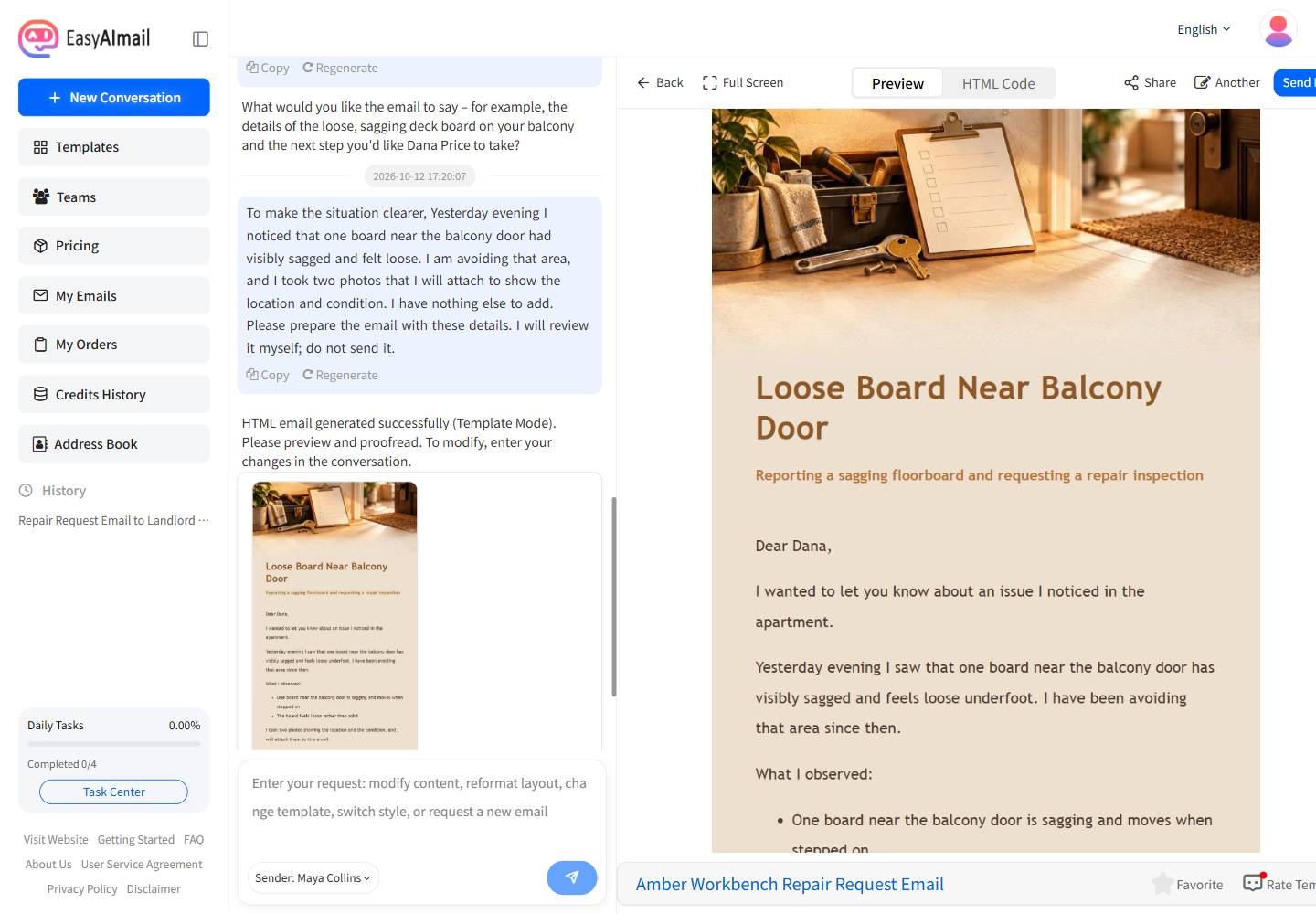
In this English-interface test, the initial need was simply a loose, sagging balcony board in a rented apartment. The later conversation supplied the facts a real repair email needs: it was noticed yesterday evening, it was near the balcony door, the tenant was avoiding the area, two photos would be attached, and weekday evening or Saturday-morning access was possible.
After the tool suggested templates, the user opened the template detail and chose Amber Workbench Repair Request Email. Its visible tags include tenant repair, maintenance request, landlord communication, housing issue, and repair request. The document-like amber workbench layout supports a factual message without making it look like an emotional complaint.
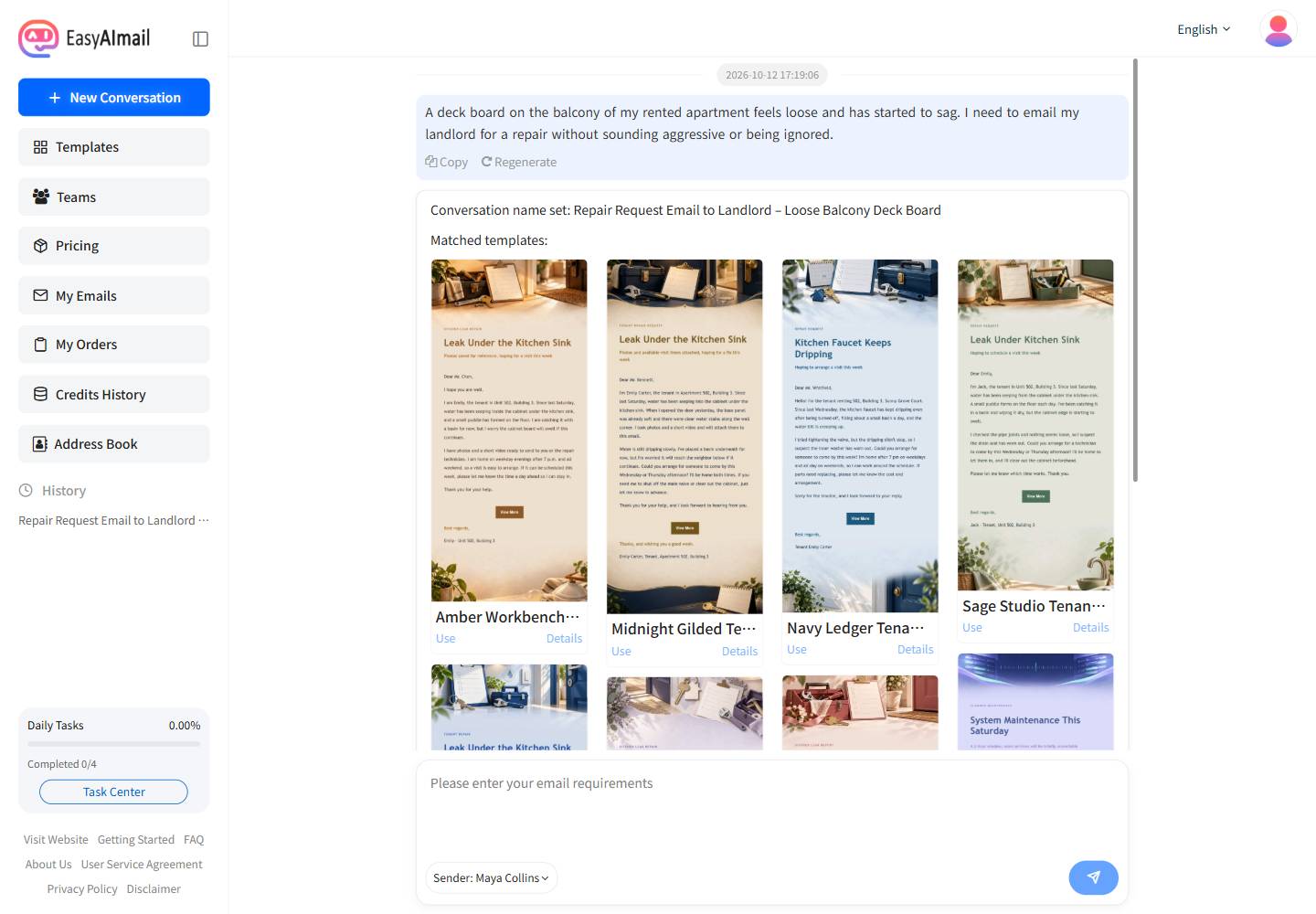
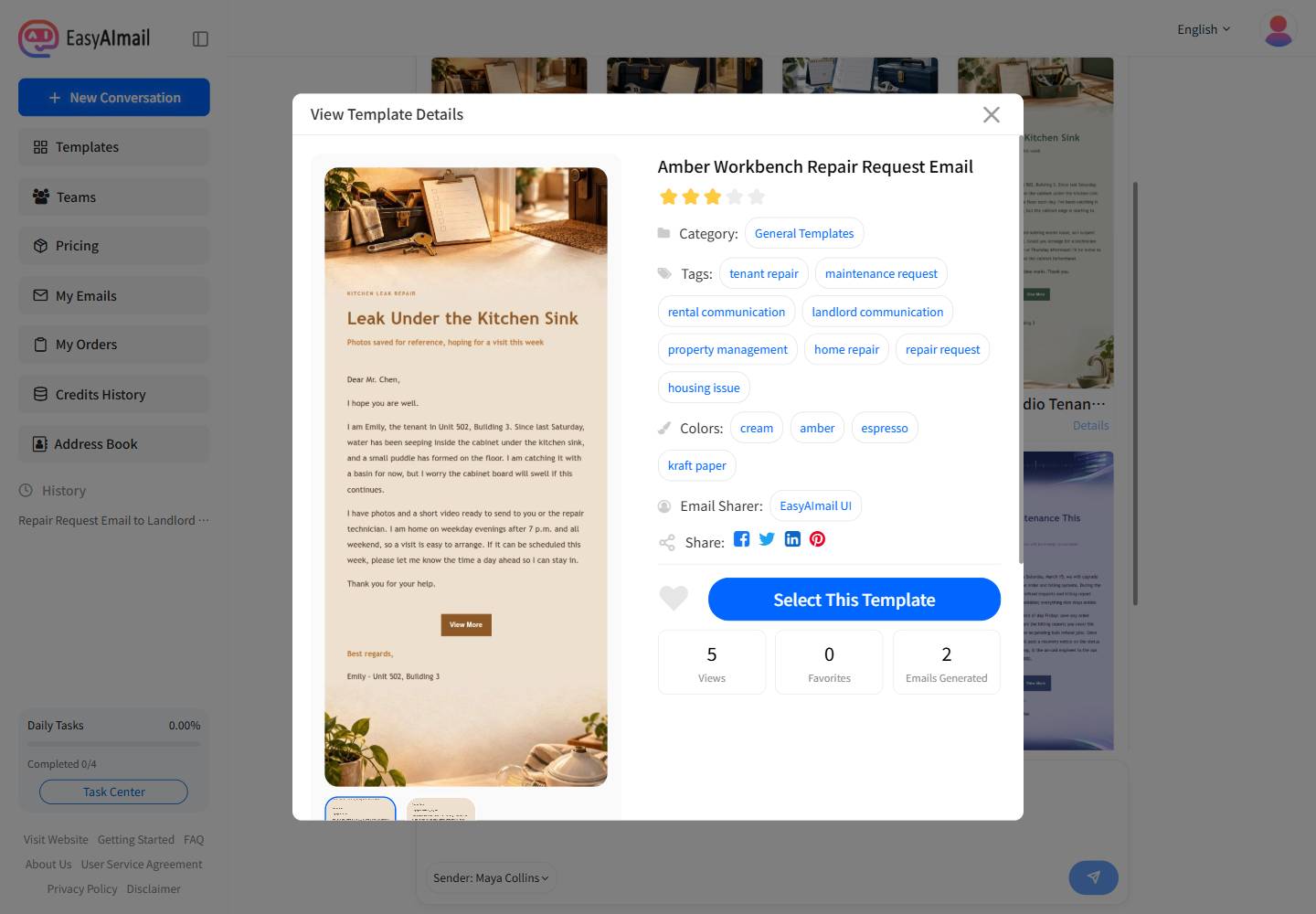
The template recommendation was a starting point, not an automatic decision. The user reviewed the detail, selected the template, answered the remaining questions, and checked the preview. No email was sent.
Follow up without rewriting the whole report
If you do not receive an acknowledgement after a reasonable interval, send a short follow-up in the same thread. Restate the location, the date you reported it, and the action you need: confirmation and an inspection or repair arrangement.
If conditions change, send a fresh factual update with new photos if helpful. There is no need to re-argue the original email. The same communication principle appears in give the other person a real status first: lead with the condition and the next step the reader needs.
FAQ
Should I include photos in a repair request email?
For a visible issue such as damage, water, cracking, or a loose fixture, photos are usually helpful. Use clear images, retain the originals, and say in the email that they are attached.
Should I demand a specific repair date?
You can ask when an inspection or repair can be arranged. Unless a date has already been agreed, avoid presenting one as a commitment the landlord made. Giving your own access windows is more useful.
What should I do if the issue feels urgent?
Use the emergency process in your lease, building policy, or local guidance for immediate safety risks. An ordinary maintenance email may still be useful as a written record, but it should not delay emergency action.
Before you send the repair request
EasyAImail can organize a practical maintenance message from the facts you provide. Describe the issue in your own words, add details as the conversation asks for them, compare recommendations, select the template yourself, and review the draft before deciding what to do with it.
Before you send it, check the location, dates, and attachments. Also check the recipient's name, your available access times, and whether the request for confirmation and an inspection is visible at a glance.
Related resources
> The people, property details, and email content in this article are fictional examples for communication guidance.