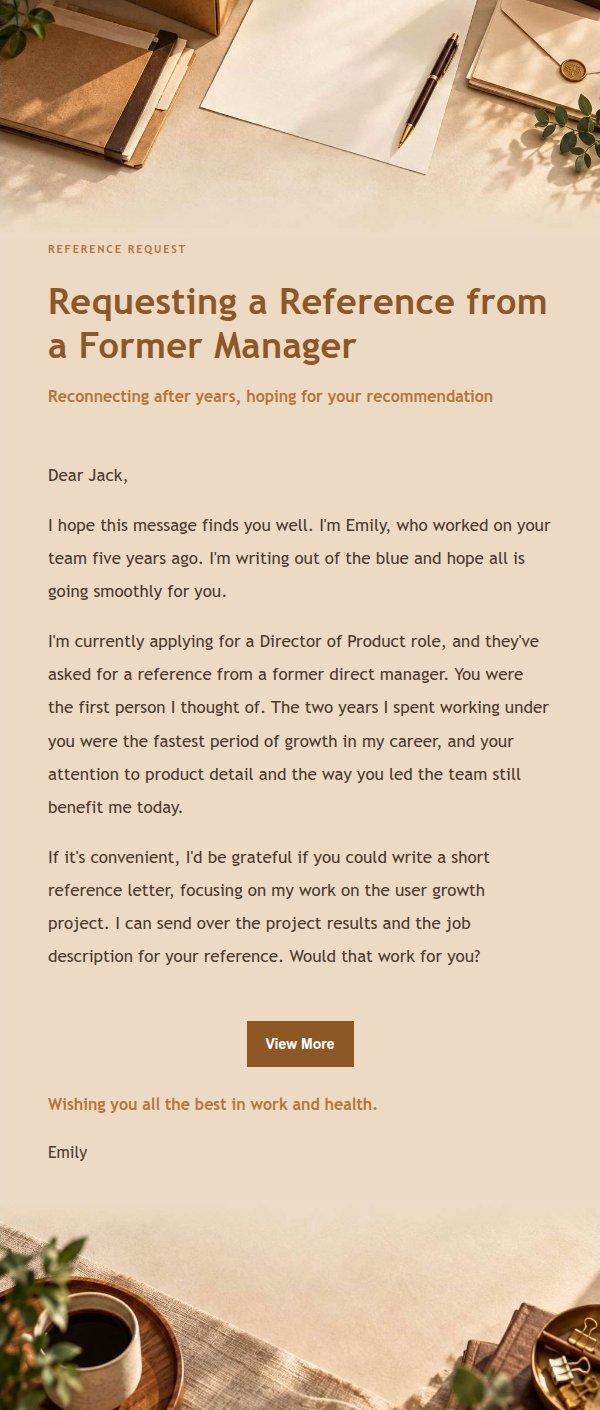
Need a reference from a former manager after years of silence? Yes, you can ask. You do not need to pretend that you stayed in touch, and you do not need to turn the opening into a long apology for the gap. A good message briefly reconnects, explains the role you are pursuing, reminds the manager of work they actually saw, and gives them a comfortable way to decline.
The aim is not to persuade someone into saying yes. It is to give them enough context to make an honest decision. That distinction makes a reference request feel more professional on both sides.
First decide whether this person is the right reference
The most senior person you once worked for is not automatically your strongest reference. A useful professional reference comes from someone who can describe how you worked: how you handled a project, collaborated with others, communicated under pressure, or followed through on responsibility.
For example, a former direct manager who watched you coordinate timelines across teams may be a much better choice for a project coordinator application than an executive who only recognized your name. The credible connection is the important part.
Good reasons to reach out
Reach out when the person supervised you directly, worked alongside you consistently, or can speak to a relevant part of the role you want next. You should be able to name one or two areas they know first-hand. That is enough; you do not need to build a case for your entire career in one email.
When to choose another person
Consider someone else if the manager barely knew your work, left before you had a working relationship, or would have to guess at what you did. If the application is not time-sensitive and you genuinely want to reconnect, a separate short catch-up email can come first. Do not manufacture a catch-up, though, just to hide the request.
Open the email without pretending the gap did not happen
One calm sentence is enough: “It has been a while, and I hope you have been well.” This acknowledges reality without asking the recipient to reassure you. It also avoids an awkward performance of closeness.
You can add a specific, true memory of the work you did together: “I often think about the cross-team rollout we worked on.” That gives the message a human starting point while staying grounded in the actual relationship.
Avoid two opposite mistakes. Do not write as though the manager owes you continued support because they once led you. But do not spend half the email apologizing for leaving or losing contact either. The purpose is a professional request, not a confession.
Explain the request in terms the manager can evaluate
The recipient needs to know what you are applying for, why you thought of them, and what you are asking them to do. “Could you be a reference?” is too bare when it arrives after a long gap.
State the role type, then connect it to work they witnessed. For instance: “I am applying for a project coordinator position, and I thought of you because you saw me manage cross-team schedules and communication.” This lets the former manager decide whether that is a fair account of their experience.
Be clear about the type of reference
Some applications need a contact whom a recruiter may call. Others require a written letter, a form, or a response by a particular date. Say which one you need. If you do not yet know, ask whether they would be comfortable serving as a reference before sending documents or deadlines.
Once they agree, make their job easier with the role description, your current resume, the deadline, and a concise reminder of the projects you worked on together. Helpful context is good; writing praise for them to copy is not.
Make declining genuinely easy
This is the part that protects the relationship. A former manager may be busy, may not remember enough detail, or may not feel able to provide a strong reference. None of those reasons needs to become uncomfortable.
Use a sentence such as: “If you do not have the time, or do not feel you are the right person to speak to this role, I completely understand.” Put it near the end, not as a dramatic disclaimer at the start.
Do not write “I really need this,” “please do not say no,” or “I hope you can make an exception.” Those phrases turn your anxiety into the recipient's responsibility. Professional courtesy means you make it easy for them to say no.
A former manager reference request email example
Subject: Would you be comfortable serving as a professional reference?
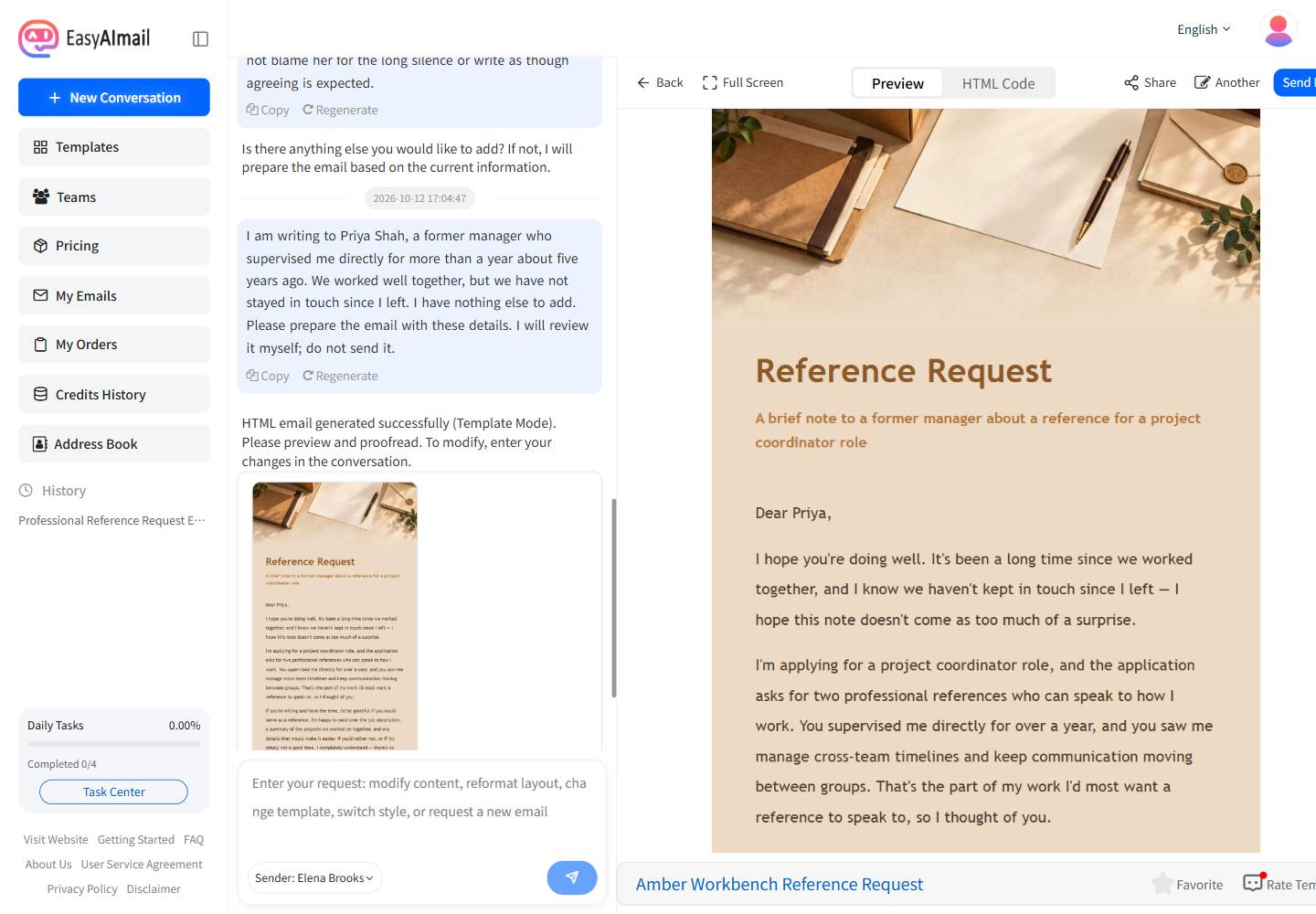
> Dear Priya, > > It has been a while, and I hope you have been well. I am currently applying for a project coordinator role, and I thought of you because you directly managed me for more than a year and saw my work coordinating cross-team timelines and communication. > > The application asks for two professional references who can speak to how I work. Would you feel comfortable serving as one of my references? If helpful, I can send the role description, my current resume, and the expected timeline. > > If you do not have the time or do not feel you are the right person for this request, I completely understand. Thank you for considering it, and for the guidance you gave me while we worked together. > > Elena Brooks
The email does not claim that Priya and Elena stayed close. It gives Priya enough information to choose, and it leaves the decision with her.
What to do after a yes, a no, or no reply
If your former manager agrees, reply promptly with the materials and the exact deadline. A short list of projects or responsibilities they observed can refresh their memory without telling them what opinion to give. Thank them after the application process too, whether or not you receive the job.
If they decline, thank them for responding. Do not ask them to justify the decision or negotiate a smaller favor. A clear no is useful information and deserves the same courtesy as a yes.
If there is no answer
After about a week, one short follow-up is reasonable when your deadline permits. Forward the original email, restate the deadline, and again make declining easy. If there is still no response, move to another reference rather than sending repeated reminders.
The same respect for choice matters in how to write a referral request email, but a referral and a professional reference are not identical. A reference needs the recipient to speak honestly about work they personally observed.
In this English-interface test: review the template before choosing it
In this English-interface test, the conversation started with a plain request for a professional reference from a former manager after several years out of touch. Details were added gradually: the manager had supervised the sender five years earlier, the new role was project coordination, and the manager had seen cross-team schedule and communication work.
After the tool recommended templates, the user opened the detail view and selected Amber Workbench Reference Request. Its visible tags include former manager, reference letter request, professional relationship, and reconnecting. The amber, cream, espresso, and kraft-paper design leaves a calm reading area for a short request rather than making the email look like a generic job notice.
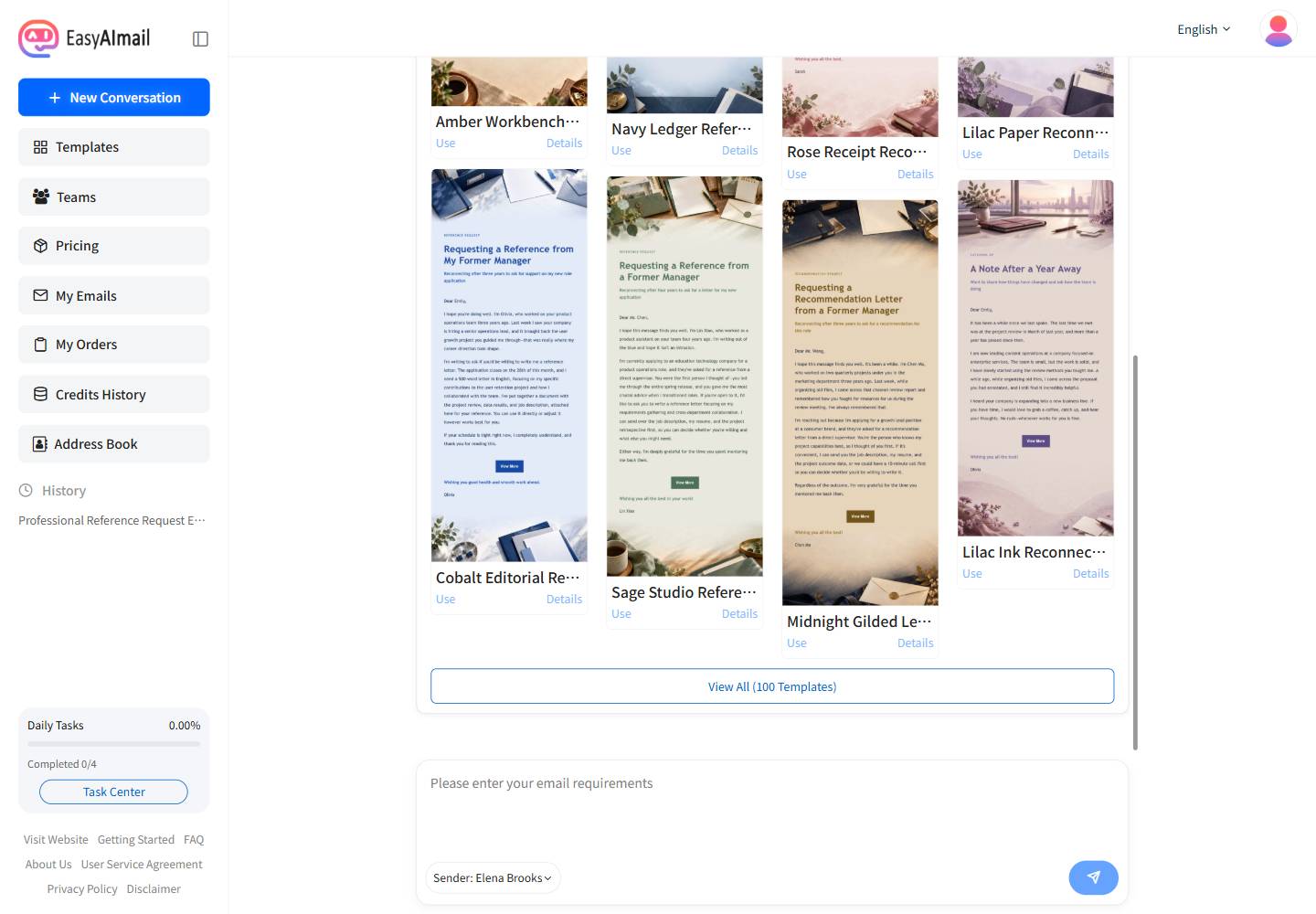
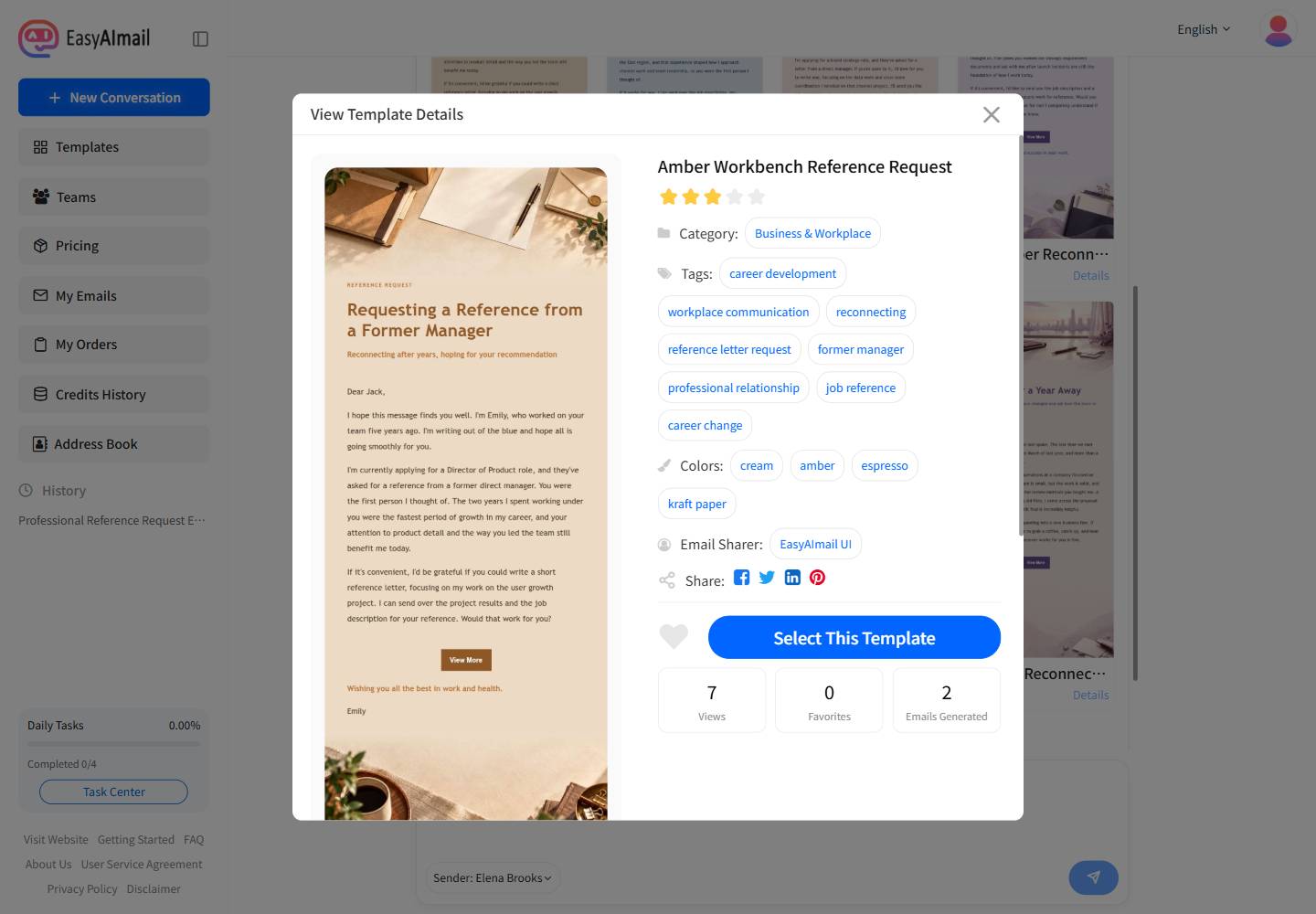
The recommendation was not an automatic choice. The user reviewed the template detail, made the selection, answered follow-up questions about the recipient and tone, then reviewed the generated email. It was not sent.
A short sending checklist
Before sending, check that the role name is accurate, the manager's name is spelled correctly, and the work you mention is something they actually saw. Remove anything that asks them to make an immediate decision unless there is a real deadline.
If they agree, do not leave them to hunt for the relevant materials. Send one concise follow-up with the job description, deadline, contact method, and your thanks.
FAQ
Is it rude to ask a former manager for a reference after years?
No, provided the request is honest and low-pressure. Acknowledge the time apart briefly, explain why you thought of them, and give them a clear option to decline. A long gap is not a reason to avoid asking a suitable person.
Should I attach my resume to the first email?
You can, but it is often cleaner to ask whether they are comfortable first. Once they agree, send the resume, role description, deadline, and any information they need in one organized follow-up.
How many former managers should I ask?
Ask the number the application requires plus a reasonable backup only if each person is genuinely appropriate. Do not send a broad, copy-pasted request to every past manager. Personal relevance matters more than volume.
Keep the request in proportion
EasyAImail can help you turn the real facts into a structured draft: explain the relationship, role, work history, recipient, and desired tone in stages; compare recommended templates; then select one yourself before reviewing the result. The tool can organize a request, but it cannot decide who owes you a reference or speak for them.
The most considerate version of this email is also the clearest one: give useful context, ask directly, and make it easy for them to say no.
Related resources
> The people, roles, and emails in this article are fictional examples for communication guidance.