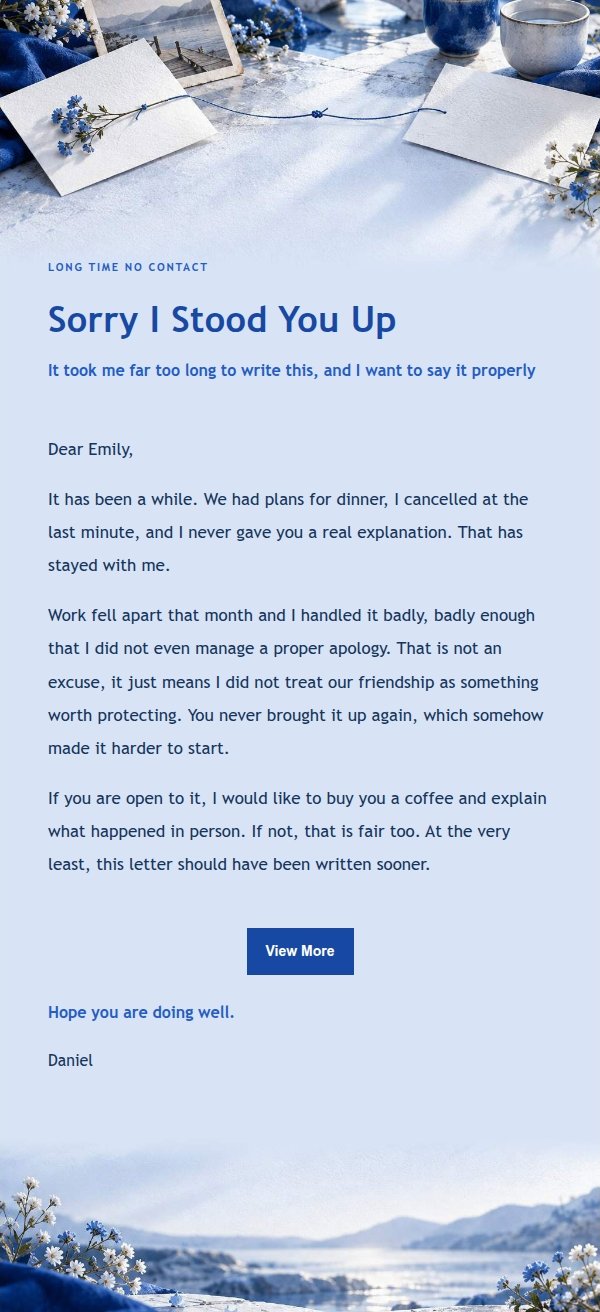
Writing to a friend after years of silence can feel risky because you cannot control how the message lands. Start by owning your part. A sincere apology names your behavior, acknowledges its impact without excuses, and leaves the recipient free to decide whether they want any response or renewed contact.
The email is not a tool for obtaining forgiveness on demand. It is a way to say clearly what you should have said, without putting the other person in charge of making you feel better.
Mistake one: retrying the old argument in the apology
When a friendship ended after a conflict, it is tempting to explain every detail: who said what, what you meant, where the other person misunderstood you. That often turns an apology into a request for a new hearing.
Repair the problem by focusing on what you did. “I made up my mind before listening to you, then avoided contact” is more useful than a long account of the argument. It recognizes a real choice without asking the friend to accept your version of the past.
Keep the detail on your conduct
Specificity matters, but the specific thing should be your behavior, not the recipient's flaws. “I did not listen to your explanation” takes responsibility. “I reacted because you were too sensitive” shifts responsibility back to them.
Mistake two: making the apology conditional
“I am sorry if I hurt you” can sound careful, but it asks the other person to prove that harm occurred. If you now understand that your behavior was hurtful, say that directly.
Try: “I understand now that the way I handled that conversation, and my silence afterward, was hurtful and immature.” You are not claiming to know every feeling they had. You are naming your own conduct honestly.
Mistake three: treating forgiveness as the answer you are owed
Phrases such as “Please forgive me” or “I need you to reply” can turn a message meant to repair harm into another demand. Your friend may be open to reconnecting, may need time, or may not want contact. All three responses are theirs to choose.
Give a real no-response option
Say plainly that you will respect no reply, then mean it. Do not follow up the next day to explain more, ask mutual friends to intervene, or interpret silence as an invitation to persuade. A boundary only works when the sender observes it too.
Mistake four: making the email about your pain
You may have felt regret for a long time. That feeling can be real without needing to fill the email. A very long account of how difficult the silence was for you can quietly ask the person you hurt to comfort you.
Three or four short paragraphs are usually enough: a greeting, responsibility, an apology, and room for the other person to choose. Personal warmth comes from accuracy, not from intensity. For a lighter personal relationship email, see writing a personal email to a friend naturally; do not simply transfer a celebratory tone into an apology.
An apology and reconnection email example
Subject: I wanted to apologize properly
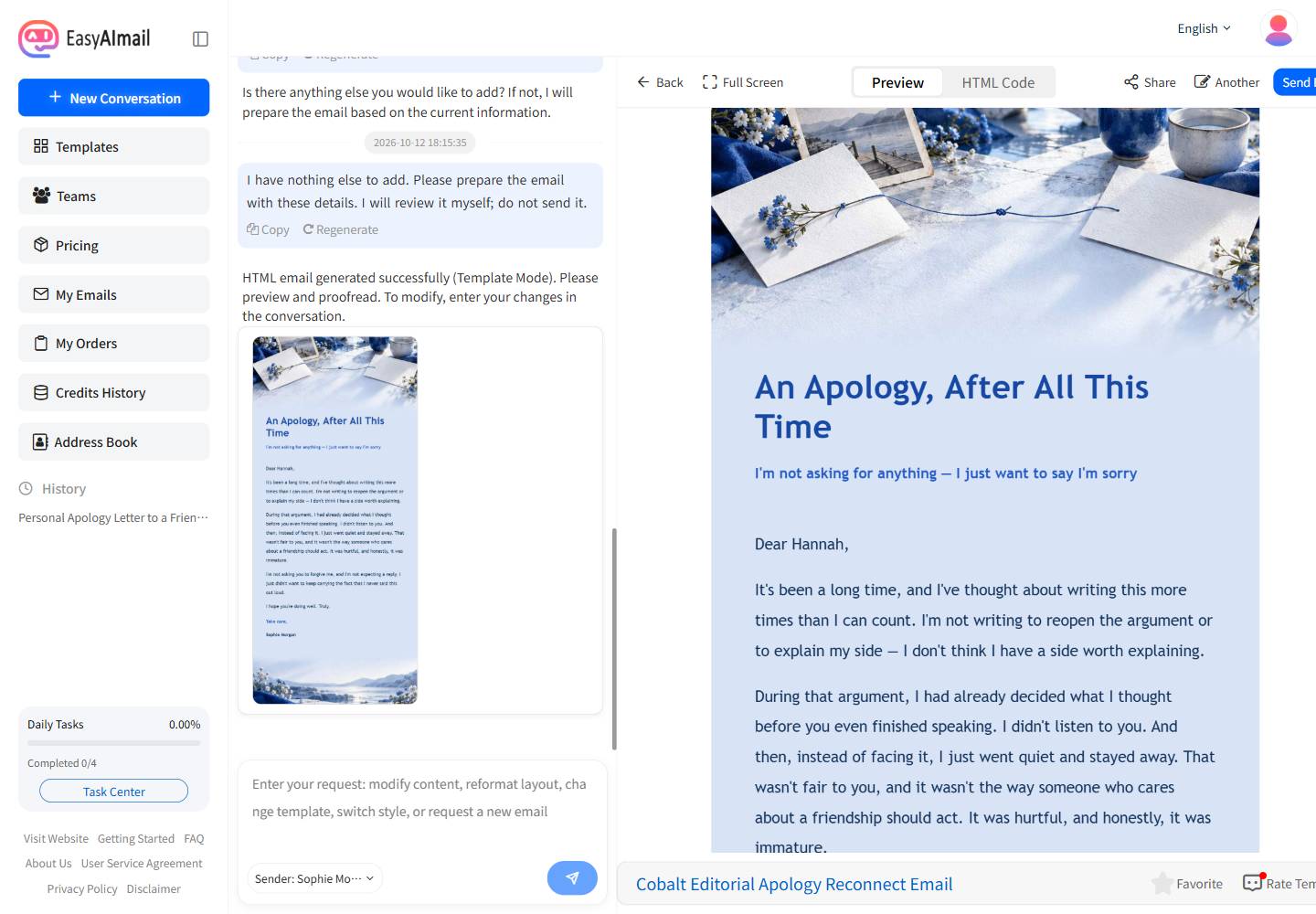
> Dear Hannah, > > I have thought often about how we stopped speaking after our argument, and I wanted to apologize properly. I made up my mind before hearing your explanation, and then I avoided contact instead of taking responsibility for how I had handled things. > > I understand now that my behavior was hurtful and immature. I am not writing to ask you to forgive me or to expect anything from you; I wanted to acknowledge my part honestly. > > If you ever wanted to reconnect slowly in the future, I would be open to that. If you would rather not reply, I will respect that completely. I hope you are doing well. > > Sophie Morgan
This message does not relitigate the conflict or demand a verdict. It separates the apology from the possibility of reconnecting.
Mistake five: choosing a message that does not fit the relationship
A business-delay layout or a generic holiday card can make a personal apology feel oddly distant. The visual treatment does not need to be dramatic, but it should leave space for a quiet, readable note. More importantly, the words must sound like a person speaking to another person, not a formal announcement.
For a professor, mentor, or other person who helped you in a more formal relationship, the balance may be different. A belated thank-you and apology after years addresses that kind of context. A friend does not need an academic tone.
In this English-interface test: choose the template after checking the detail
In this English-interface test, the user began with only the central need: a personal apology to a university friend after an argument and a long period without contact. Later messages added the relevant facts: the sender had judged before listening, then avoided contact for three years; the goal was to apologize, not to demand forgiveness or an immediate return to the friendship.
The user reviewed the recommendation details and selected Cobalt Editorial Apology Reconnect Email. Its visible tags include apology to a friend, mending a friendship, taking responsibility, reconnect, and long time no contact. The cobalt-blue, porcelain-white, silver, and restrained cyan design reads like considered personal stationery while keeping the text central.
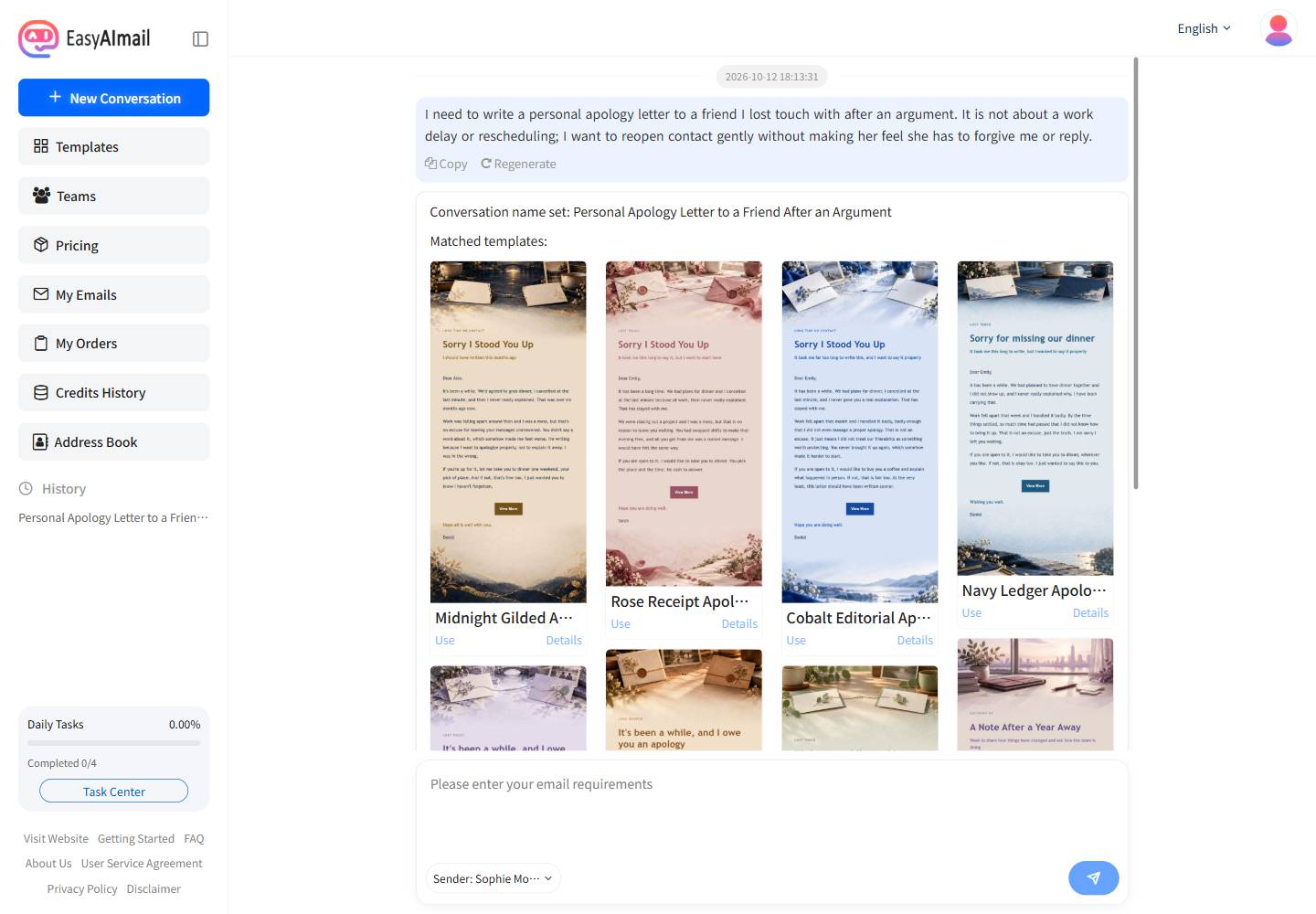
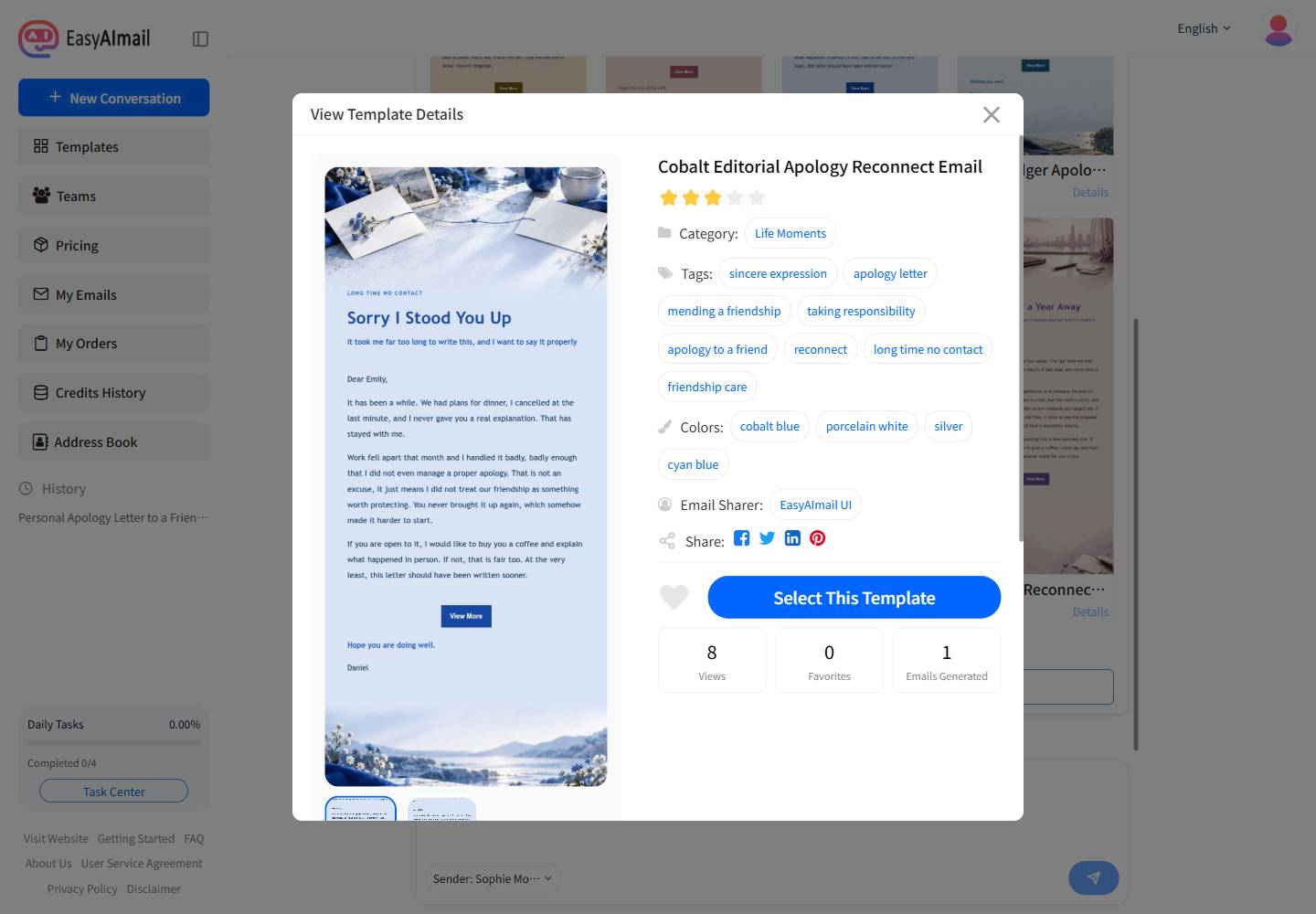
The tool did not make an emotional decision for the user. It recommended options; the user opened the detail, selected the relevant template, supplied the recipient name and boundaries, and reviewed the final preview. No email was sent.
If your friend replies
Listen before explaining. They may want to describe what the experience was like, ask for more time, or say they are not ready to reconnect. A short response such as “Thank you for telling me; I am listening” is often more respectful than rushing to demonstrate how much you have changed.
If they do not reply, accept that as a possible outcome. The value of a sincere apology is not measured by whether it restores the relationship. It is measured by whether you said your part truthfully and respected their autonomy afterward.
FAQ
Should I explain why I acted badly?
You can give brief context, but it should not erase accountability. If the explanation starts to sound like evidence that your friend should not have been hurt, leave it out.
Should I ask to meet in the first apology email?
You can leave it as a low-pressure possibility, such as being open to talking if they ever want to. Do not propose a fixed meeting or ask for an immediate decision.
How long should I wait before sending an apology?
There is no perfect interval. The more useful question is whether you can take responsibility without demanding an outcome. If you can respect a non-response, you are closer to being ready to send the message.
Let the recipient set the pace
EasyAImail can help you shape a message from the facts you choose to share: explain the relationship, what you did, what you want to acknowledge, and the boundary you want to preserve. The conversation can ask for missing details and offer templates to inspect, but the decision to choose, edit, preview, or send remains yours.
The final discipline is simple: apologize for your conduct, do not request a reward for it, and leave the pace of any response with them.
Related resources
> The people, relationships, and emails in this article are fictional examples for communication guidance.