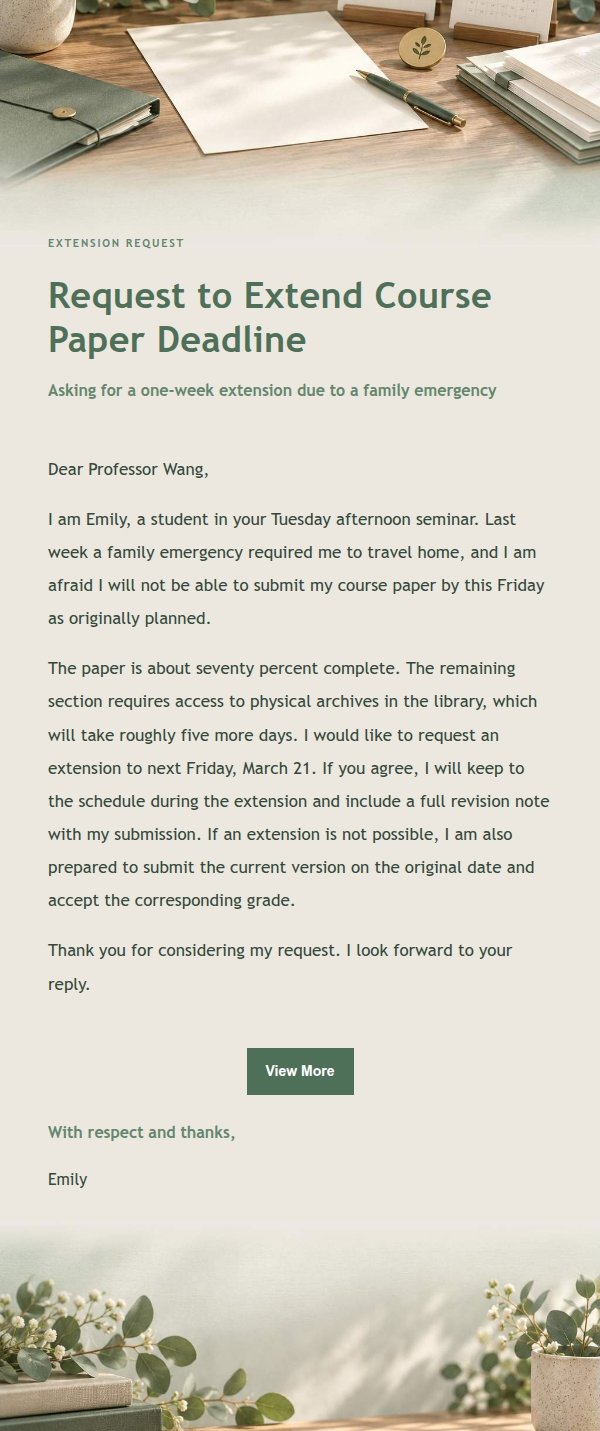
The hardest part of asking for an extension is not writing a longer explanation. It is giving enough context without sounding like an excuse.
Start by making the email a responsible request about a current course. Write early, give brief and truthful context, say what progress you have made, propose a realistic new deadline, and leave room for the professor to say no. You are not asking them to solve your situation. You are giving them the information needed to decide whether an extension is possible.
This is not a reconnection or apology email
Writing to a professor after years of no contact requires a different balance. How to Write a Thank-You and Apology Email to a Professor After Years is about appreciation, a delayed apology, and reopening a relationship. An extension request is about an active course and a time-sensitive academic decision.
That difference changes what belongs in the email. Your professor needs to identify the course and assignment, see the original deadline, understand what has affected the work, and evaluate the date you are asking for. They do not need a long self-critique or an account that makes them feel responsible for comforting you.
Ask as soon as you see the problem
Email when you realize the deadline may not be realistic, not a few minutes before the submission system closes. Asking early does not guarantee an extension, but it gives the professor a real opportunity to consider the request and shows that you did not leave the decision until the last moment.
If the deadline has already passed, a short honest email can still be better than silence. Acknowledge that the work is overdue, say what you have completed, and ask what next step they would prefer. Do not turn a late message into a second, longer story about why you could not write sooner.
Give the facts a professor can actually use
Most clear extension requests include five facts:
- The course and the assignment.
- The original due date and time.
- The progress you have already made.
- Brief, truthful context about what affected the work.
- A specific new submission date.
Describe the impact without oversharing
"An unexpected family-care responsibility affected my progress last week" can be enough context. You do not need to disclose a relative's diagnosis, family conflict, or every private detail. More personal detail does not automatically make a request stronger. Never invent documents or evidence to make the request sound more serious.
Propose a date you can meet
Choose the date from the work remaining, not from what sounds optimistic. If you have only started, do not request tomorrow simply to look committed. If you have an outline and sources already organized, a specific later date and time may be realistic. Your professor should not have to guess what an extension would accomplish.
Assignment extension email example
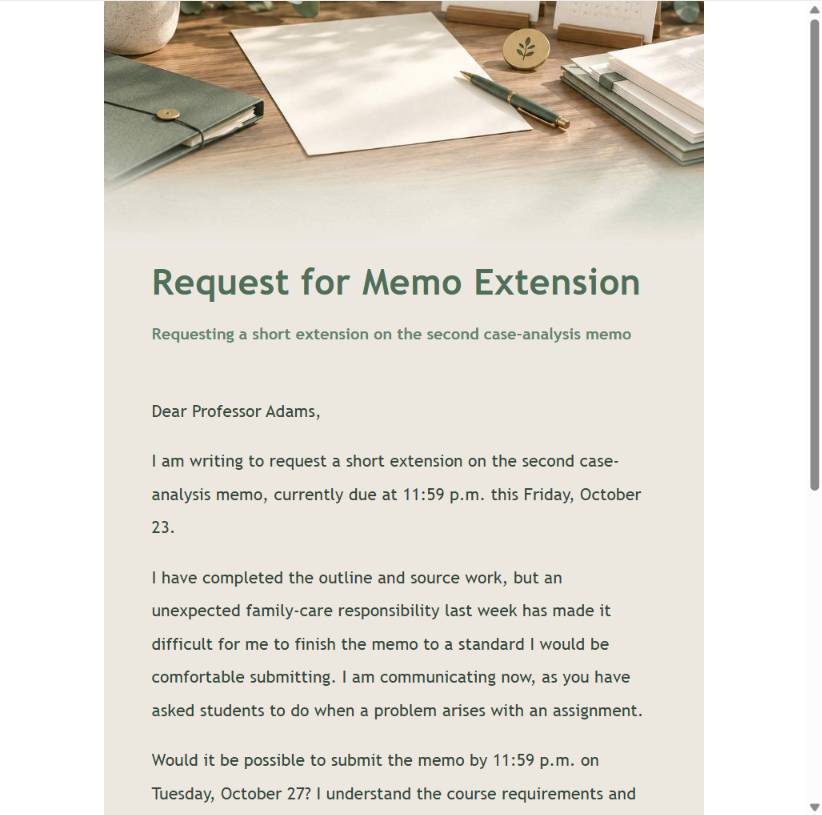
Subject: Request for an extension on the second case-analysis memo
Dear Professor Adams,
I am writing to request an extension for the second case-analysis memo in Research Methods. It is currently due at 11:59 p.m. this Friday, October 23. I have completed the outline and source work, but an unexpected family-care responsibility last week affected my progress on the remaining sections.
Would it be possible for me to submit the memo by 11:59 p.m. on Tuesday, October 27? I understand the course requirements and that you may not be able to approve an extension. If it is not possible, I will follow the course requirements and your direction.
Thank you for considering my request.
Noah Bennett
The example does not make the difficulty sound larger than it is, and it does not assume that an extension will be granted. It gives the professor a clear request and an honest fallback.
Avoid language that shifts the burden to your professor
Phrases such as "I am completely overwhelmed," "this would ruin everything," or "I really need you to make an exception" can make the recipient feel pressured. So can a long narrative, blaming a teammate, or implying that the professor must rescue you from a situation.
Stay with what you can own: what you have completed, what affected the schedule, what you are asking for, and how you will proceed if the answer is no. Sincere does not mean emotionally intense. It means accurate, accountable, and easy to act on.
If the professor declines or does not reply
Your professor may approve the request, suggest a different date, direct you to an established process, or decline it. Reply briefly to acknowledge the decision, then ask only the next practical question if one is necessary, such as whether you should submit the completed portion under the normal rules.
Do not treat no reply as approval. If the deadline is close, continue working toward the original requirement or submit what you can complete. Course, department, and institution rules may affect what happens next, so follow the published guidance and the professor's direction. This email structure is not academic policy, medical advice, legal advice, or a way to create evidence after the fact.
What the visible template review showed
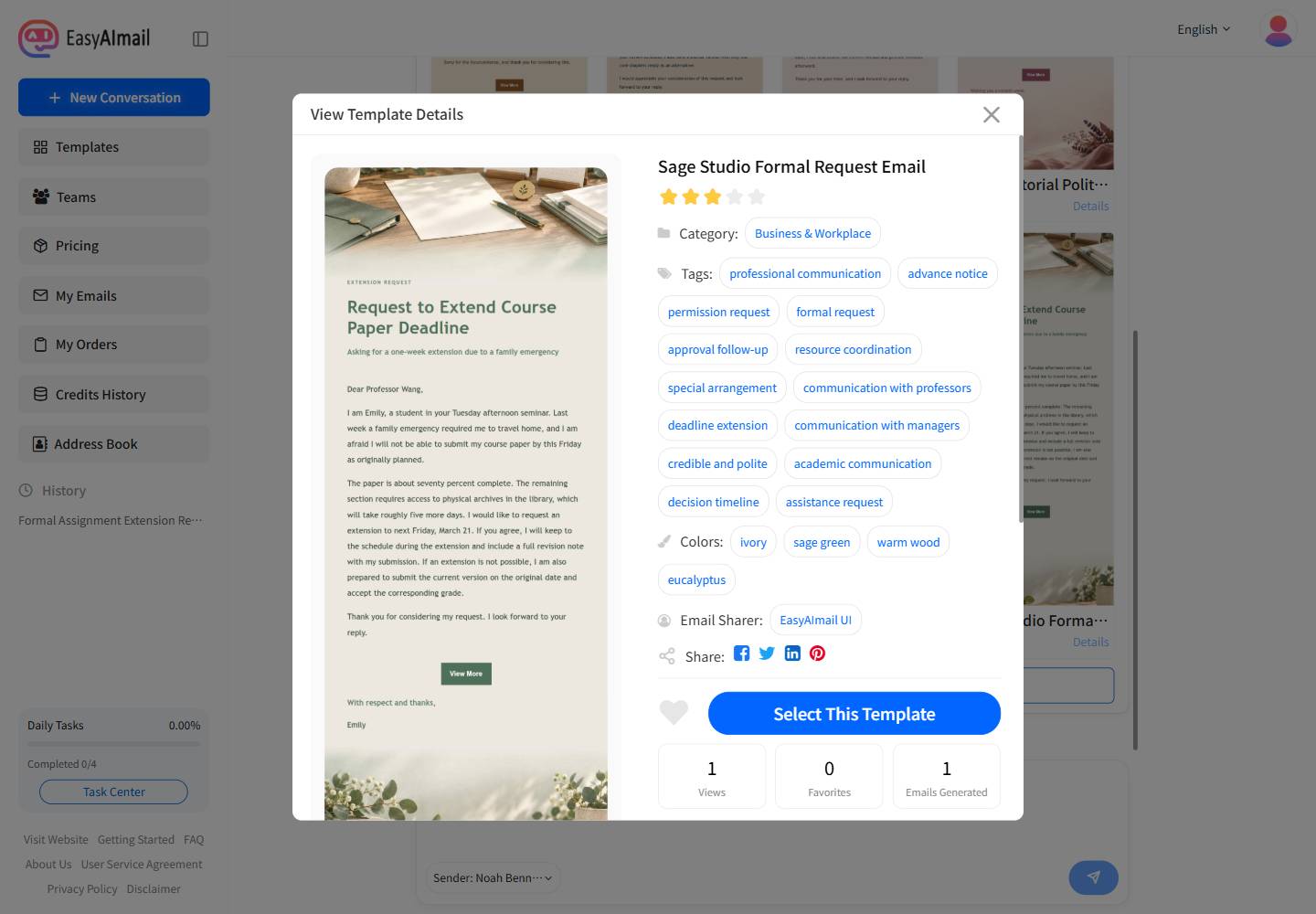
In this English-interface test, the simulated user reviewed the detail view before selecting Sage Studio Formal Request Email. The visible tags included communication with professors, academic communication, formal request, deadline extension, and credible and polite. Its description also emphasized showing the original and proposed arrangements clearly. That is useful for an extension request because the professor can find the deadline and the proposed alternative without hunting through a long explanation.
For other message types and visual styles, see the Free Email Template Collection: Choose One by Scenario. A template can make the information easier to scan; it cannot decide a course policy or guarantee that a professor will grant an exception.
Use EasyAImail to put the facts in order
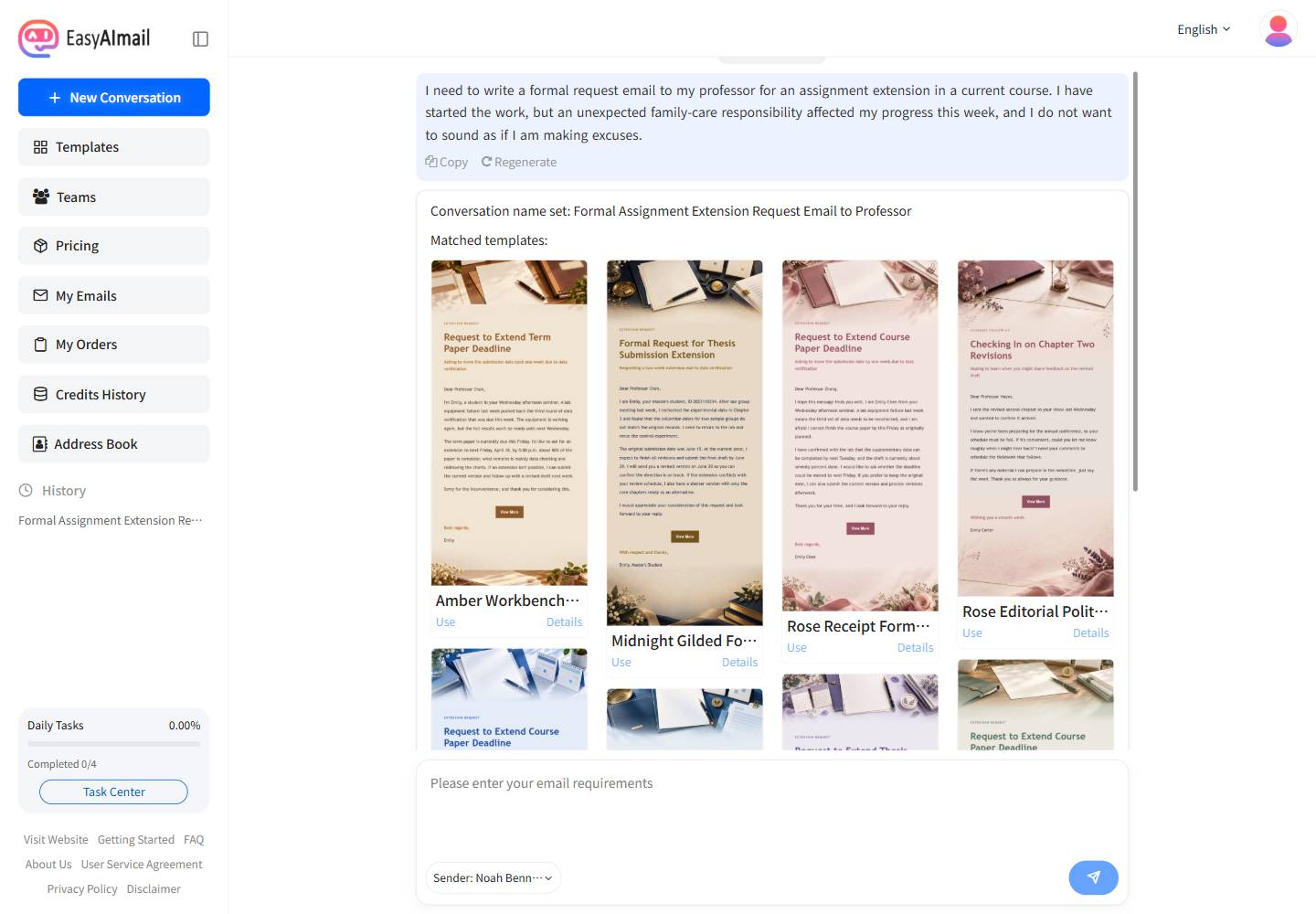
In EasyAImail, you can start with the real problem: "I need to ask my professor for an assignment extension and do not want to sound as if I am making excuses." AI can recommend relevant templates, but it does not select one for you. You can open the details, read the purpose, tags, examples, and visual style, then choose the template yourself.
Once you choose, the conversation can collect the professor's name, assignment, original deadline, progress, requested date, and tone one piece at a time. Before the draft is generated, you can add any missing detail or confirm that there is nothing else to include, then review the result yourself. EasyAImail is a conversational writing tool. It does not provide school policy, medical or legal judgments, advice on fabricating evidence, or automatic email sending.
Before you send it, check
- Did you identify the course, assignment, original deadline, and requested new deadline?
- Have you given enough truthful context without exposing private details you do not need to share?
- Did you mention your actual progress instead of only saying that you are behind?
- Did you acknowledge that the professor may not be able to approve the request?
FAQ: Common questions
Do I need to provide proof when asking for an extension?
Requirements vary by course and institution. Check the syllabus and any guidance your professor has already given. If you are unsure, you can ask whether there is a specific process to follow. Do not create or exaggerate proof to strengthen the request.
Can I ask for an extension on the due date?
You can, but earlier is better. On the due date, be especially clear about the current deadline and the date you are requesting, and understand that the professor may not have time or discretion to approve it.
Can I assume an extension if my professor does not reply?
No. Silence is not permission. Continue working toward the original requirement or submit the work you can complete, and send one brief follow-up only if necessary to confirm that the request was seen.