Wanting more time after an offer does not mean you are ungrateful. You may need to confirm a start date, think through relocation, or read the role details calmly. A vague delay, though, can look like lost interest.
Start by treating the message as a small, formal request, not a defense of your hesitation. Thank them, name the exact date you are asking for, and make room for the possibility that the company cannot change its timeline. That is usually more reassuring than a long explanation.
Do not confuse this with an interview follow-up
There are two nearby situations that call for different emails. If a recruiter promised next steps and then went quiet, read How to Follow Up After an Interview When You Have Heard Nothing. That message asks for clarity about a process that has stalled.
This article starts later: you already have a formal offer and an answer-by date. You are not asking the employer to speed up a decision or prove that they still want you. You are requesting a short, defined window to make your own decision carefully.
If you have a real offer from another employer and want an update from the company you prefer, the more specific situation is How to Follow Up After an Interview When You Have Another Job Offer. That can justify mentioning an actual deadline. It is different from using another offer as leverage when replying to the offer already in front of you.
Decide what the extra time is for
Before you ask, be honest with yourself about what a few more days will resolve. Perhaps you need to confirm whether the proposed start date works, discuss a move with a partner, compare the written terms with what you heard in interviews, or review a benefit that matters to you. You do not need to put every private detail in the email.
You do need a plan. If you are ready to accept and are only delaying because the moment feels large, an extension may not help. If you know you plan to decline, asking for extra time simply postpones a clear answer. A short extension makes sense when it gives you time to finish a real piece of decision-making.
Ask early and give one exact date
Write soon after you receive the offer, ideally with at least one business day left before the original deadline. A request made early feels like normal planning. A request made in the final hour can create avoidable uncertainty for everyone who is coordinating the role.
Name both dates: the current deadline and the date you hope to use instead. "Could I have a little more time?" creates another task for the recruiter. "Could I respond by Wednesday, October 28 instead of Friday, October 23?" gives them something concrete to approve or decline.
Keep the request short enough to keep
Ask for the smallest realistic extension. Two or three days is easier to evaluate than an open-ended week, and it is easier for you to honor. Do not request a new deadline that you already suspect you will miss. A second delay after an extension does more damage than a candid first request.
Include four things and leave out the pressure
A useful request has four parts:
- Thank the recruiter and team for the offer and their time.
- Say you are reviewing the details carefully.
- Ask to move the response deadline to a specific date.
- Acknowledge that the employer may not be able to extend it.
That is enough. You do not have to list your financial comparisons, family discussions, or every uncertainty you have. Avoid saying that you have better options, asking them to "hold the role," or framing the note as a negotiation move. The purpose is not to make the company worry about losing you. It is to make your request easy to understand and answer.
A concise reason sounds more responsible
One sentence such as "I would like a little more time to review the start date, relocation arrangements, and role details carefully" is usually sufficient. It shows that the extra time has a purpose without asking the recruiter to manage your personal decision.
Job offer deadline extension email example
Subject: A small request about the offer response deadline
Dear Ms. Bennett,
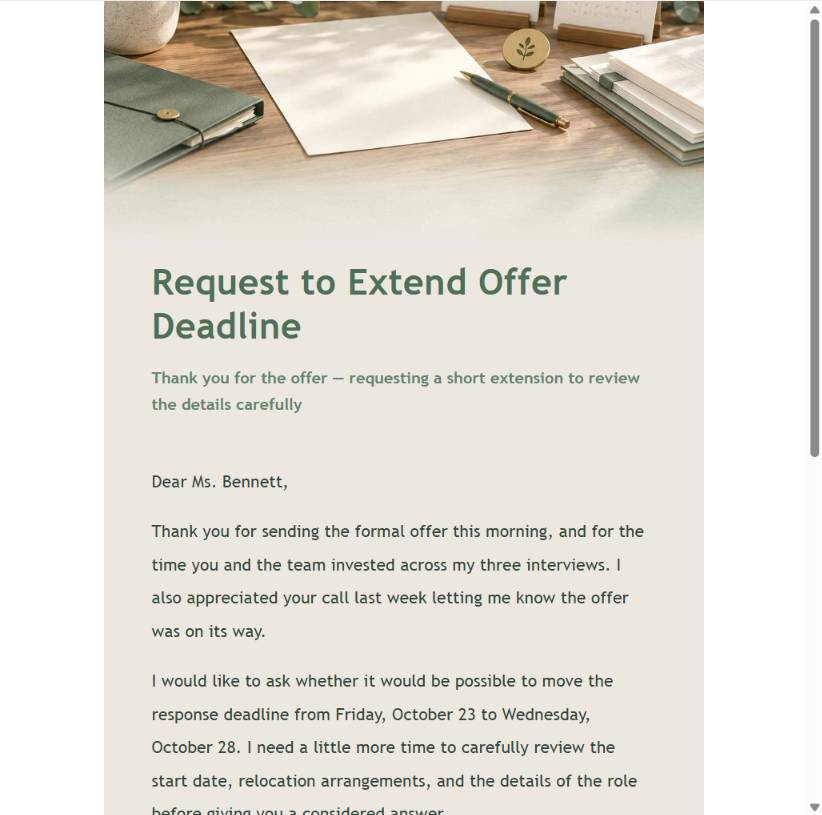
Thank you very much for sending the formal offer this morning, and for the time you and the team invested throughout the three interviews. I am very interested in the opportunity and would like to review the start date, relocation arrangements, and role details carefully before giving you a considered answer.
The current response deadline is Friday, October 23. Would it be possible to extend it to Wednesday, October 28? I understand that your hiring timeline may not allow for an extension, and if that is the case, I will provide a clear response by the original deadline.
Thank you again for your consideration.
Erin Walsh
Notice what the example does not do. It does not apologize for having a decision to make, and it does not turn the request into a threat. The reader can see the request, the date, and the respectful fallback immediately.
If the answer is no, or only partly yes
The company may grant it, offer fewer days, or keep the deadline. Reply briefly, thank them for the answer, and make your decision within the timeline you then have. Repeating the request after a clear refusal rarely improves the situation.
If you discover that you cannot make a decision by the original date, say so rather than disappearing. An offer is a decision on both sides. Clear communication is more professional than trying to keep every option open through silence.
What the visible template review showed
In this English-interface test, the simulated user opened the detail view before choosing Sage Studio Formal Request Email. The visible tags included professional communication, formal request, deadline extension, decision timeline, and credible and polite. Its description also centered on showing an original arrangement and a proposed arrangement clearly. Those signals fit an offer-deadline request because the message needs a specific date without a confrontational tone.
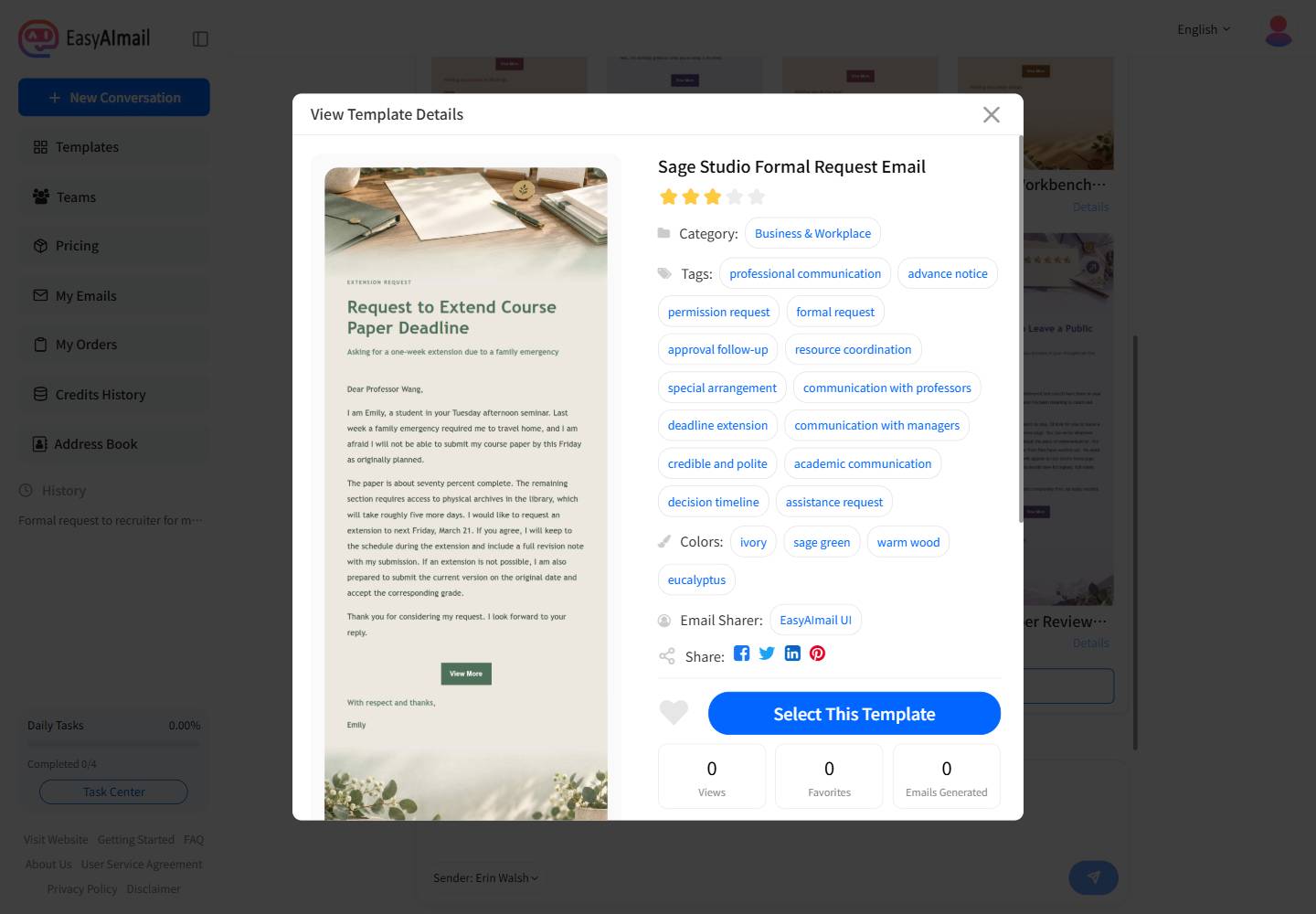
A visual structure can make a request easier to scan. It cannot tell you whether you should accept the offer, decide whether your reason is sufficient, or promise a deadline on your behalf.
Use EasyAImail to clarify the request before you write
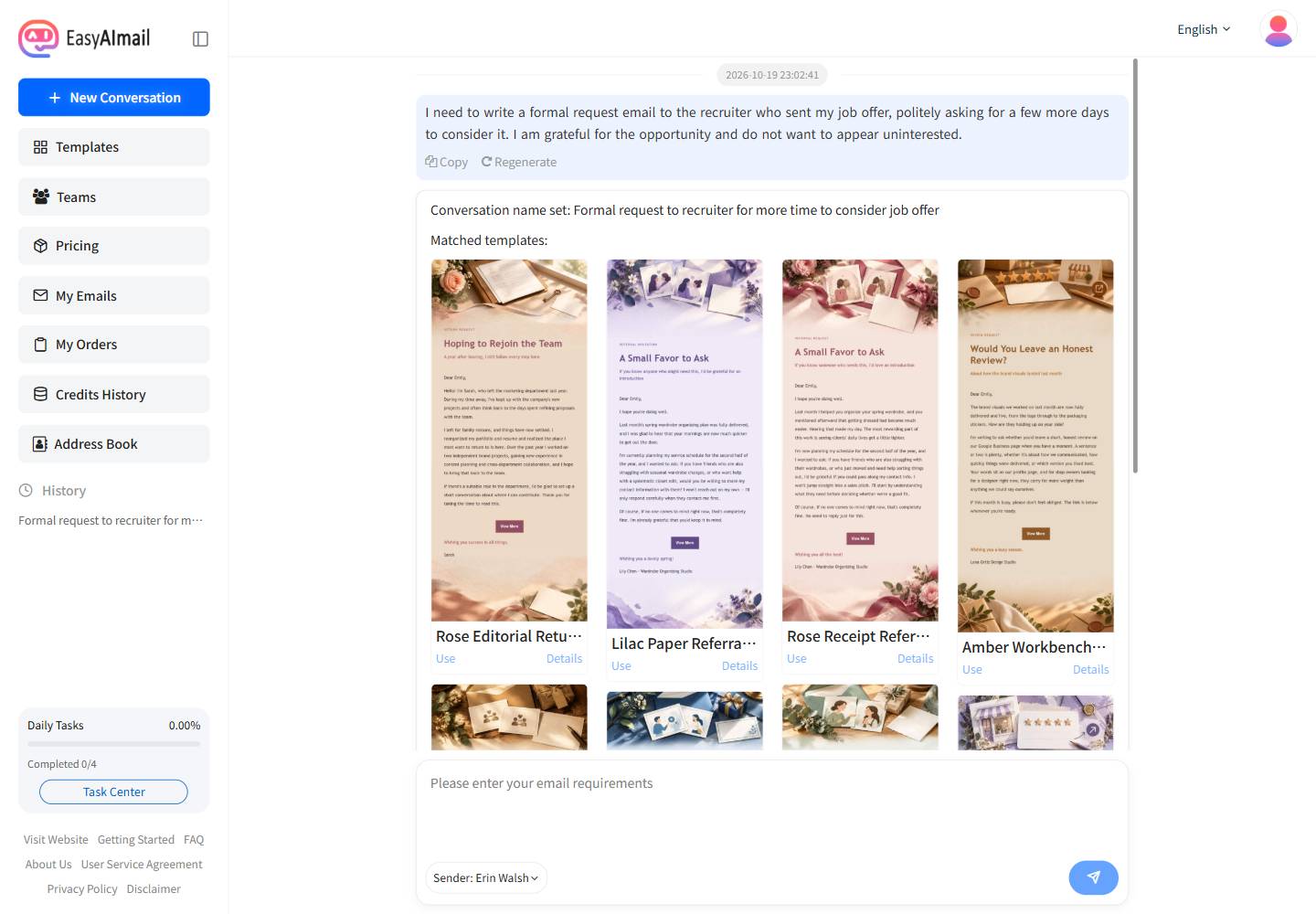
In EasyAImail, begin with the real tension: "I received a job offer and would like a few more days to consider it without sounding uninterested." AI can recommend relevant templates, but it does not choose one for you. You can inspect the purpose, tags, examples, and visual style, then make the final choice yourself.
After a template is selected, the conversation can gather the recruiter name, current deadline, proposed date, and tone one detail at a time. Before generation, you can say whether there is anything else to add, then review the email yourself. EasyAImail helps put a real request into clear words. It does not make career decisions or send the email automatically.
Before you send it, check
- Did you ask for one specific new response date?
- Is the reason concise, with no unnecessary private detail or implied pressure?
- Did you thank the employer and acknowledge that an extension may not be possible?
- Can you genuinely give a decision by the date you requested?
FAQ: Common questions
How much extra time can I ask for?
Ask for the shortest amount of time that lets you finish the real decision. A few days or a short business week is usually easier to consider than an undefined delay. The important part is that you can keep the date you request.
Should I mention another offer?
Not for this situation. You can simply say that you are reviewing the offer carefully. Mention another offer only when it is formal, has a real deadline, and is directly relevant to a separate follow-up with the employer you prefer.
What if the recruiter does not respond before the deadline?
Do not assume silence means approval. If the deadline is close, send one short confirmation asking whether they saw the request, while still preparing to decide by the original date.