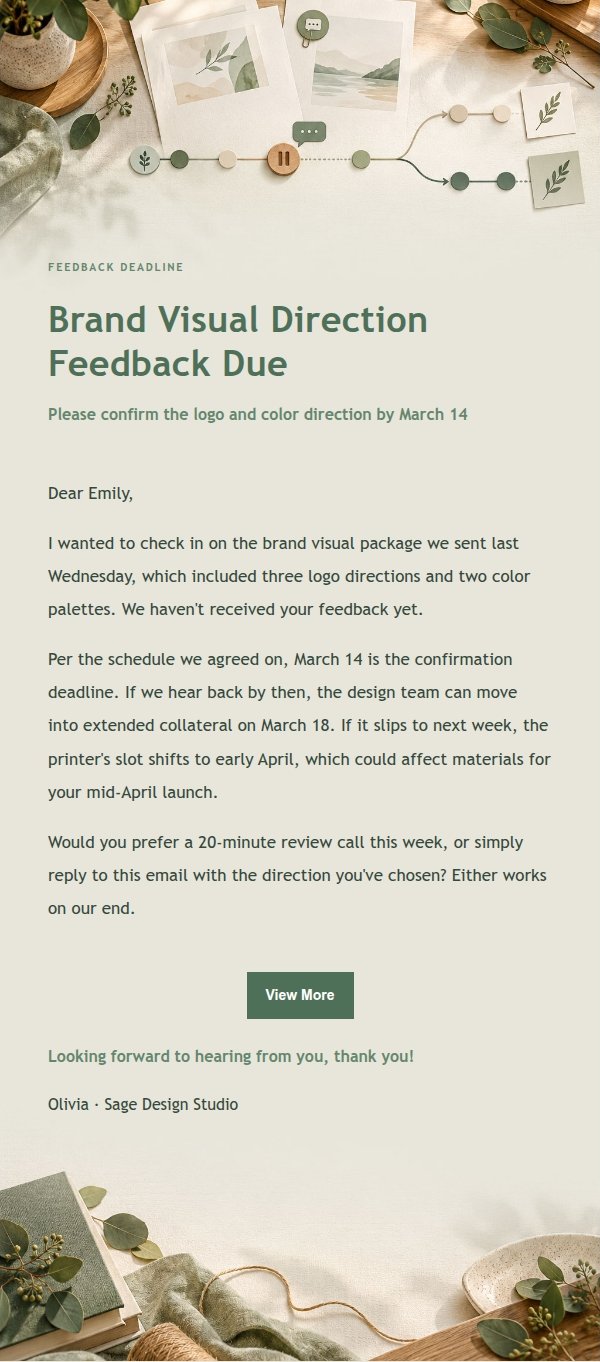
A client who has gone quiet is not necessarily saying no. They may be busy, waiting on someone else, or unsure what needs approval. But a project cannot stay suspended forever. The hard part is asking for a decision without making a good client feel blamed.
Start by turning the follow-up into a small decision: name the version, list the open items, give a real deadline, and say what happens to the schedule if feedback is not ready. That is clearer than "just checking in" and kinder than vague pressure.
This is not the same as chasing missing client materials
There are two adjacent problems that need different emails. When a client has not delivered copy, images, or other inputs, you need a missing-project-materials email with timeline options. When they already have your draft, the question is whether they can make a decision on a specific version.
That distinction changes the body of the email. Do not re-explain the entire project or ask for "any thoughts." Tell them what is open: three headings, a delivery note, or a single approval. A busy person is more likely to answer a contained request than a broad invitation to review everything again.
Replace "Any update?" with a decision they can make
"Just following up" is polite, but it gives the recipient work. They need to find the old draft, remember the context, and decide what response you expect. A usable reminder makes that effort smaller.
Include four facts:
- what you sent and when;
- the exact points still awaiting feedback or approval;
- the latest time you need a response;
- the scheduling consequence if that response is not ready.
Use a date and time you can actually honor. Do not say that silence counts as approval unless that is an explicit, established agreement between you and the client.
Explain the schedule without making it a threat
The sentence to avoid is: "Please reply soon or we will be delayed." It leaves the client with guilt but no useful picture of the work.
Try a scheduling fact instead: "We can hold this production slot until 3 p.m. on Wednesday. If we do not have feedback by then, we will release it and schedule the next available slot after approval, which is likely about five business days later." The difference is small but important. You are explaining how capacity is allocated, not punishing the client for being busy.
Phrases that usually make a reminder feel harsher
"Final notice," "you are holding up the project," and "no response will be treated as approval" can turn an ordinary follow-up into a confrontation. Unless those phrases reflect a process the client already agreed to, stay with the facts: what is ready, what you need, and what date affects the schedule.
Give a deadline and an honest way out
A deadline works best when it comes with an option for someone who cannot meet it. For example:
- Approve the listed items or mark changes by Wednesday at 3 p.m. so the current production slot stays in place.
- Reply with a more realistic review date, knowing that the next slot will be scheduled after that confirmation.
The second option is not a weakness. It gives the client a way to respond without pretending they can review something immediately. That is often what stops a follow-up from being ignored again.
Client approval reminder email example
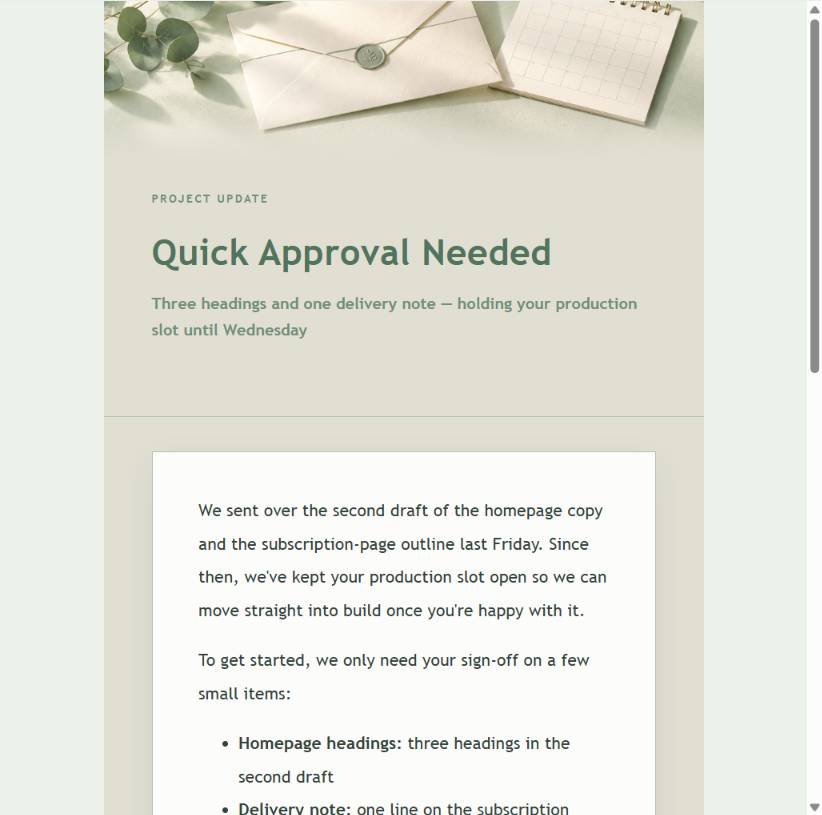
Subject: Confirming the homepage draft and production timing
Dear Maya,
I sent the second draft of the homepage copy and subscription-page outline last Friday. Before we move into the next production step, I need your confirmation on the three headings and the delivery note, or any edits you would like made to this version.
We can hold the current production slot until 3 p.m. this Wednesday. If we receive your feedback by then, we can continue on the original pace.
If this week is not a good time to review, that is completely fine. We will release the current slot and schedule the next available one once we have your feedback, which is likely to move the work by around five business days. You can also reply with a date that is more realistic for you, and I will update the plan from there.
Thank you,
Paige Morgan
Harborline Studio | Client Project Lead
The point of this message is not to win an argument. It makes the decision and its practical effect visible, while leaving room for the client to give you better information.
What to do before and after the deadline
Before the deadline, make review easy. After it, state the real schedule. If an internal stakeholder still needs to look at the draft, agree on the next update date. If there is no reply, say that the slot has been released and ask when they would like to restart the review.
What the visible template review showed
In this English-interface test, the simulated user reviewed the detail view before selecting Sage & Ivory Polite Follow-Up Email. Its visible tags included client follow-up, gentle reminder, milestone reminder, pending reply, progress check-in, and no-pressure expression. The description also emphasized explaining the reason, background, impact, and next step in that order. Those are useful signals for an approval reminder; color alone would not be enough reason to choose it.
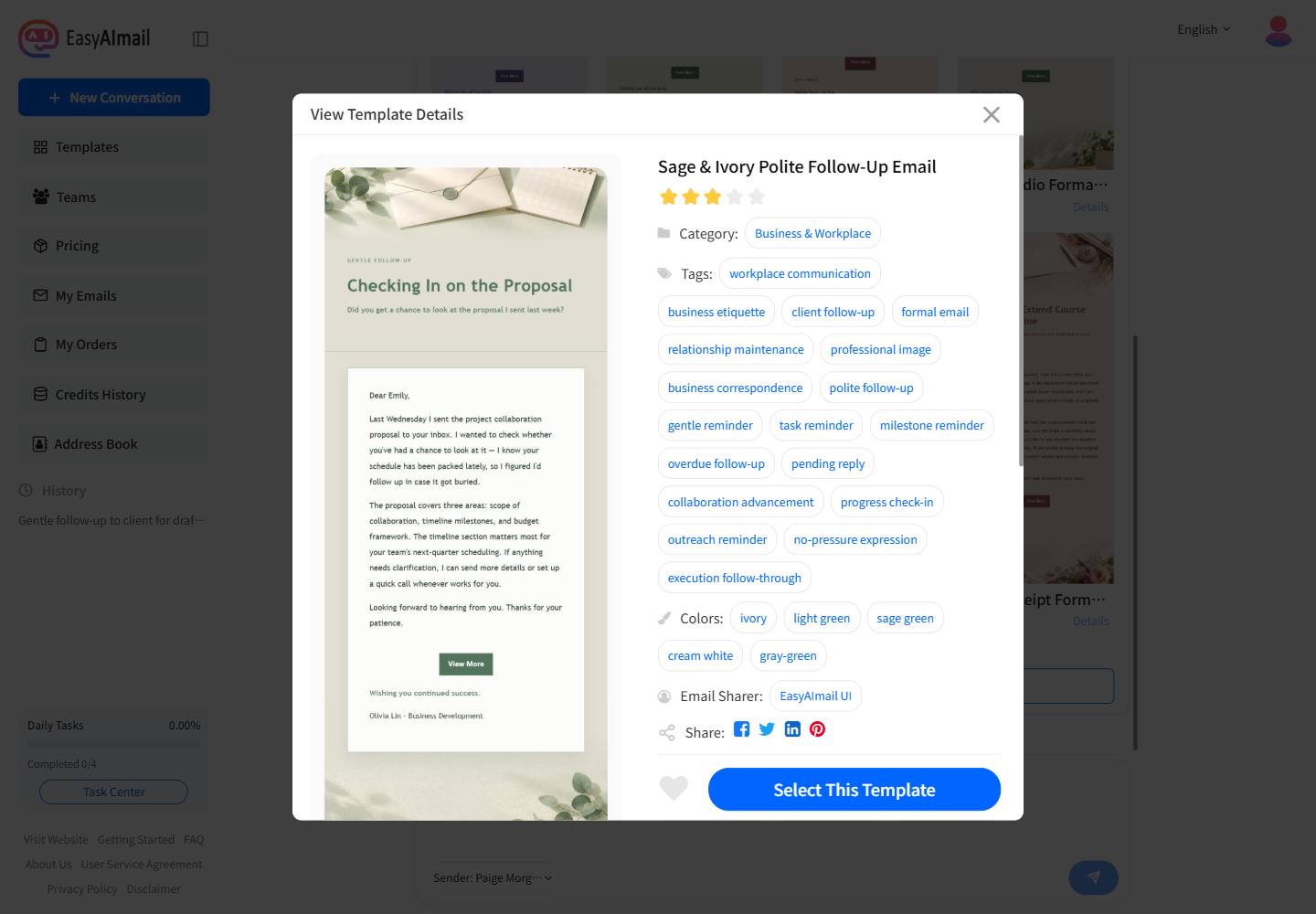
The template can support a considerate structure, but it cannot decide whether your deadline is fair or whether you can really release a production slot. Put those facts in yourself before sending.
Use EasyAImail to clarify the real request first
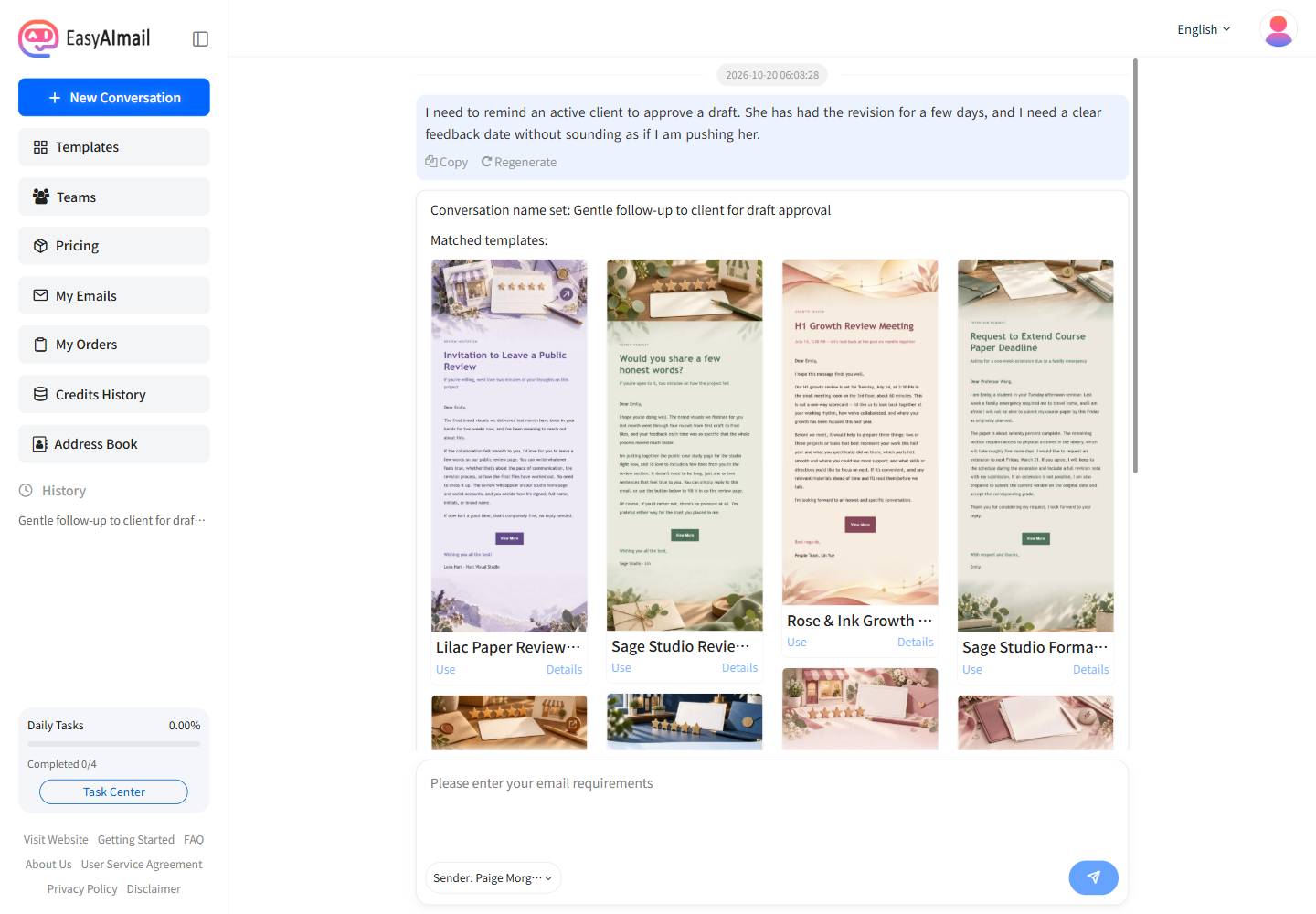
In EasyAImail, you can begin with a natural description such as "My client has the revision but has not approved it, and I need a clear feedback date without sounding pushy." AI can recommend relevant templates, but it does not choose one for you. You can open the details, check the purpose, tags, sample, and visual style, then decide whether to use it.
After that, answer the follow-up questions one piece at a time: the recipient's name, what still needs approval, the deadline, and the tone. Before generation, you confirm that there is nothing else to add, then review the result yourself. Template choice, project commitments, and sending all remain with you.
Before you send it, check
- Have you named the exact approval items instead of asking generally for feedback?
- Is the deadline real, specific, and clear in the recipient's time zone?
- Have you described the scheduling consequence without claiming that silence is approval?
- Can the client reply with approval, edits, or a more realistic date in one short message?
FAQ: Common questions
How long should I wait before following up again?
If you gave a clear deadline, one or two business days after it passes is a reasonable time for a short scheduling update. If the client told you they need internal review, follow the next update date you agreed on instead.
Can I say that no reply means approval?
Do not use that as a default line in a normal follow-up. Whether it is appropriate depends on the contract, established workflow, and applicable rules. A safer everyday approach is to say that you will release the current slot and wait for a new confirmation.
What if the client says they have not had time to look yet?
Thank them for the update, ask for a realistic review date, and adjust the schedule accordingly. Holding a slot indefinitely rarely helps either side unless you have explicitly agreed to do so.
If the delay is on your side rather than the client's review, read How to Tell a Client About a Delay Before They Have to Ask. The responsibility and the email structure are different.